The U.S. & Nunarput (Greenland) - The Danish Imperialist Dimension
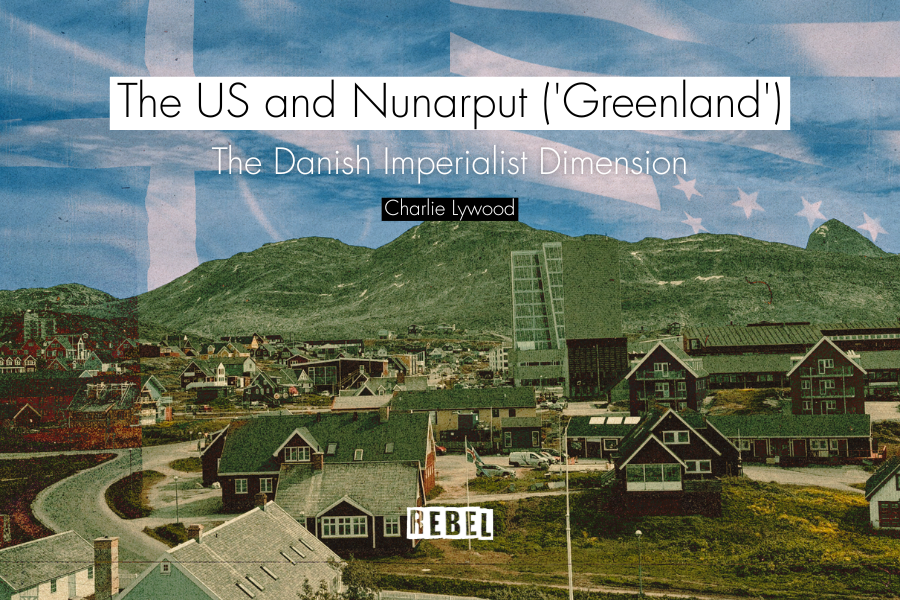
Donald Trump has chosen his next target, Nunarput (Greenland)[mfn]Note: The author has gone with the name Nunarput, because it means their "land" (nuna) in Greenlandic, as opposed to "Kalaallit Nunaat" (Greenlanders' Land), which is a translation of the colonists' (Denmark's) term for the country.[/mfn]. His talk of annexing Nunarput is a reality. The United States has just proven what the U.S. government is ready to do by kidnapping the Venezuelan president, Nicolás Maduro, and taking control of their oil. Now Nunarput is in the frame. How should we react to this and what role does Danish imperialism play in all this?
Notwithstanding the crimes of colonial Denmark, anti-imperialists and socialists must, of course, unite to reject and fight Trump's imperialist plans for Nunarput. The joint meeting between Vance, Rubio and the Danish and Inuit representatives in Washington did not, for the moment, change the US position.
Rivalry to the fore
The US attack on Venezuela, and Trump's clear statement that it is about controlling oil are an expression of a shift in the imperialist system. Imperialist wars are no longer paper wrapped with phrases like "humanitarian intervention" or "exporting democracy". We are now in a period of intense rivalry in the imperialist system, with the US and China as the major players, but where the EU, Russia and Israel and others also try to assert themselves in their own regions. Nunarput is now at the center of this rivalry.
When Trump talks about "security" he refers to the U.S. aiming to control Nunarput's rare earth resources to compete with China in a crucial area where it is currently lagging behind.
Nunarput is also strategically well placed in relation to major trade routes, where climate warming makes it possible to sail through the Bering Strait – even in the winter months. The United States now wants to rob a colony from another colonial power, in this case Denmark.
In this interimperialist rivalry, one imperialist should not be supported against another. We should not, like the right wing - and unfortunately also socialist parties in the Danish Folketing (Parliament) - call on the EU or NATO to intervene militarily in the conflict. For example, the leader of the Red-Green Alliance, Pelle Dragsted, has chosen to whip up militaristic and imperialistic feelings by calling on the Danish military to place more soldiers on Nunarput and allow other European countries to place troops there.
Belligerence left and right
This is quite in-line with the Red-Green Alliances stand on Ukraine where they have been one of the most belligerent advocates of sanctions and military support for Ukraine. Even to the extent of supporting Danish donations of F16 jetfighters.
It is also in alignment with the Danish ruling class who now have a double strategy of, on the one hand, attempting to “up the ante” against the USA and at the same time appearing to appease Trump. The Danish Defence Minister, Troels Lund Poulsen, is organising an immediate NATO military mission from various European countries in Nunarput. And at the same time he has ordered a contingent of soldiers to prepare for an increased Danish military presence on the island. Neither of these moves would have been made without consultation with top European figures. It is certainly not in line with the Inuit government, who up to now, have wanted to de-escalate military presence on and around the island.
Denmark or the EU are unlikely, realistically, to challenge US´s military superiority, but they want to push the costs of attaining Nunarput for the US as high as possible. Whatever the outcome, the rush to match the US militarily will continue.
Denmark in growing inter-imperialist rivalry
It’s important to understand that Denmark is part and parcel of the inter-imperialist rivalry and, together with the rest of the EU, wants to strengthen itself against the United States. That is why they say they stand together with Nunarput. Not because Denmark or the EU cares much about the welfare of the Inuits, but because continuing European control of Nunarput can strengthen Denmark’s role.
A shock wave went through the Danish ruling class last week when the five parties that make up the Nunarput parliament (Inatsisartut), in a common declaration, made it clear that Nunarput was not for sale and that all threats would meet with rejection. That was unsurprising. The shock was that Denmark, which Nunarput is officially part of – the so-called “commonwealth” (Rigsfælleskab in Danish) – was not even mentioned.
Official Denmark went into self-spin and Jens-Fredrik Nielsen, as chairman for Nunaputs government (Naalakkersuisut), and Inuits generally were attacked in the media and social media for being ungrateful to the Danes and they could just “go it alone” if they wanted too. Words like traitors and so on were used.
This prompted a statement from Jens-Frederik Nielsen stating that of course Nunarput was a part of the “commonwealth” of Denmark, Nunarput and the Faroe Islands. Prime minister Mette Frederiksen declared that “Greenland stands together with Denmark, NATO and the EU”. Any talk about independence he said, should be left to after this crisis with the US. He had been called to heel.
The reason for this panic is that for Denmark’s ruling class, the loss of Nunarput would be a massive blow to their status in NATO as the country that rules Nunarput and its strategic importance and wealth of mineral resources. Independence is of course a possibility in the future but that would be a process that the Danes could control and ensure their continued involvement both militarily and economically. They wanted Inuit leaders to align with Denmark during the crisis and upcoming negotiations with the US.
Colonialism and its Inheritance
On the surface all political parties (apart from the extreme nationalist right wing) support independence for Nunarput but really this is just hot air. If they really back independence, which is the wish of the vast majority, as the last elections in Nunarput reflected, the Danish government should openly declare it. Instead, they say, mealymouthed, “Greenland’s future should be decided by the Greenlanders themselves”.
Nunarput as administratively a part of Denmark receives the same welfare that the rest of the country gets. Particularly in education and health, this is important. If Nunarput becomes independent, then the grants from the state (redistribution of state taxes) that goes to all regions of Denmark, will be revoked. This is the reason why the Inatsisartut (parliament) wants to take the separation from Denmark gradually and negotiate the terms.
If the ruling class of Denmark really wanted to help Nunarput independence, then they should be talking about paying reparations for the hundreds of years of colonial rule and the damage done to Inuit society through the years.
Danish colonialism in Nunarput
In 1721 an expedition led by the Danish-Norwegian missionary Hans Egede was sent to Nunarput, where he encountered an Inuit population that had been on the island with their Thule culture for hundreds of years. Notwithstanding, Egede established a Danish colony consisting of a trading post and a mission. God and imperial trading went hand in hand. From then on Nunarput was under Danish colonial rule.
In 1917 Denmark made an imperial deal with the USA. They sold the Virgin Islands that they had colonised in the slave trade era – Denmark was the sixth largest slave trading country – to the US. In return they got the US to recognise Danish rights to Nunarput. The indigenous people’s rights were completely ignored.
After the second world war Denmark was faced with another problem. The United Nations committed to securing the rights of colonised peoples and many colonised peoples to fight – through armed struggle if necessary – for independence.
The Danish government maneuvered to sidetrack the issue. They persuaded the Inuit leaders that they would grant Nunarput the status of municipality. In return, Inuits got Danish citizenship. But they also got an aggressive policy of cultural assimilation, whereby Danish became exclusively the official language in Nunarput. Inuit youth had to travel to Denmark (3500 kilometers from the capital of Nunarput, Nuuk) to get a high school exam.
In the period 1966 to 1975, 4,500 girls and women had IUDs inserted, which corresponded to half of the fertile women in the country. Many of the mothers were teenagers. A large proportion were unaware of what was happening and, in many cases, it was done forcibly or through manipulation and without consent.
Socialist Answers
Denmark presents itself, as so many colonial states have done through history, as a benign well-intentioned parent who is looking after its “children”. The reality is very different. Denmark has destroyed the Inuit culture and done immeasurable damage to countless generations of Inuits. At the same time Danish companies have mined and fished their way through Nunarput´s natural resources.
Socialists should, instead of cheering on this or that imperialist state or bloc, we should put our trust in completely different forces. The working class in the United States, Denmark and Europe as well as the Inuit's own strength, unity and resistance. We look to all ordinary workers who are victims of the rivalry of those in power. We look to their solidarity. Dockworkers have the power to prevent ships from leaving the ports. Workers in the military industry can strike. Workers in uniform can turn against their officers. The Danish working class can and must act and support the Inuit's right to determine their own future.
Note: The author has gone with the name Nunarput, because it means their "land" (nuna) in Greenlandic, as opposed to "Kalaallit Nunaat" (Greenlanders' Land), which is a translation of the colonists' (Denmark's) term for the country.