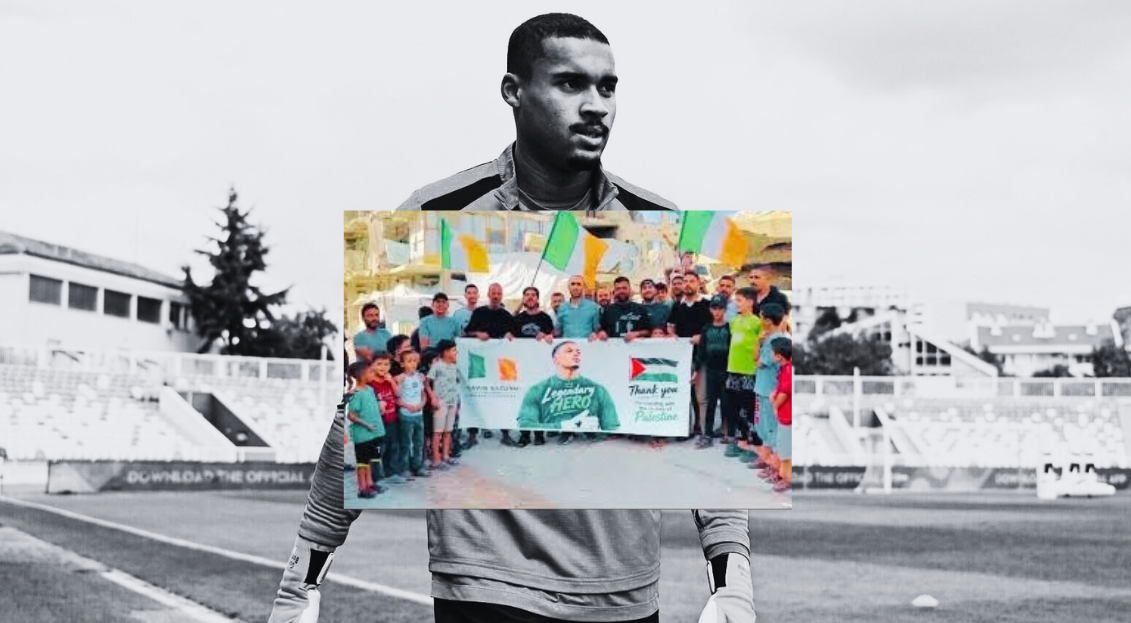
Gavin Bazunu is an Irish hero.
Last Sunday night, the Irish men’s football team played Israel.
This was the first of two fixtures against Israel in the European Nations League, the least prestigious of the three regular international football tournaments Ireland participates in.
Although it was an official home game for the Israeli team, the match took place in a supposedly neutral venue in Hungary, and the 20,000-seater stadium was virtually empty, with only a few hundred Israeli fans (and an apparent handful of Irish men who somehow obtained tickets through the Israeli football association).
During the match, Israeli fans chanted their support for their soldiers in the IDF and subjected Irish players of colour, such as Adam Idah, to racist abuse.
While RTE broadcast the game, it did so without its usual panel of pundits and with an external (British) commentary team.
Although in purely footballing terms Ireland emerged as comprehensive winners, in a much more meaningful sense, we all lost something on Sunday night.
We are now more than three years into a genocide inflicted by the Israeli state against the Palestinian people in Gaza.
In the occupied territories of East Jerusalem and the West Bank, Israeli settlers are accelerating their campaign of ethnic cleansing, with the backing of the Israeli military.
While Russia, following its invasion of Ukraine, faced immediate expulsion from essentially all international sporting and cultural events, Israel has faced no such official sanction.
The leading football bodies, FIFA and UEFA, have defended Israeli participation using tired, disingenuous old tropes about “sport not mixing with politics” (where genocide is disgustingly regarded as mere politics) and vacuous calls for “unity not division.”
Ed Sheeran’s speech, following his decision to side with a billionaire stadium owner against his own support acts, was brimming with such weasel phrases.
Boycott, Divestment and Sanctions
Israel’s genocide is a logical consequence of the Zionist project to colonise Palestine but resistance has taken many forms.
It has inspired international movements of solidarity and a BDS campaign of Boycott Divestment and Sanctions against Israel.
As with the South African case, this campaign includes a call for the boycotting of sporting and cultural events involving Israel.
The Palestinian people face overwhelming odds. They are subjugated by a state which is vastly more powerful militarily (one with nuclear weapons) and armed and backed by the United States, the UK and the European Union.
Thus, international solidarity, and especially the BDS movement, is an essential part of their resistance.
This was the context for yesterday’s game. A virtual picket line was established in support of Palestine and against genocide.
Over the preceding year, ever since Ireland and Israel were drawn to play each other, the challenge was put to all those with the power to stop the game, in particular UEFA, the Football Association of Ireland and the Irish government, to make sure that this picket line was not crossed.
Given Ireland’s experience of colonial repression, which included a genocidal famine in the mid-nineteenth century, there is enormous sympathy for the Palestinian cause here.
Unsurprisingly, the Stop the Game (really two games) campaign was immensely popular amongst Irish fans.
Many former players and managers, particularly James McLean, Richie Sadlier and Brian Kerr, spoke out strongly against playing the match.
One survey of 214 professional footballers in Ireland found that 63 per cent felt Ireland should not play, while a separate public poll reported 71 per cent would support the FAI, if it cancelled these fixtures.
Public strength of feeling was such that there was no way the home match could take place in Dublin. Alternate venues were found.
Various other concessions were made, such as not selling tickets to Irish fans and, in RTE’s case, not having a panel discussion. But none of these came close to respecting the picket line.
As the games approached and the pressure grew, it was clear that the footballing authorities were unwilling to do more and that the players themselves would have to decide on this.
At times, especially Saturday morning, it looked like the campaign might work.
In the days before the match, Irish manager Heimir Hallgrímsson, reluctantly in favour of playing, was clearly struggling to justify it.
He absurdly described Ireland’s task as “playing against genocide,” a statement which, as well as trivialising the Israeli state’s colossal crimes, made no sense on its face.
If you accept there is a genocide, how could you even countenance playing a football match with players, many of whom served in the very Israeli army committing it?
During a chaotic few hours, when scheduled press conferences and training sessions were postponed, players apparently debated over what to do and voted with an unknown majority to proceed with the match.
It is unclear what role the manager, officials from the FAI, and especially players’ agents, played in all of this.
It seems likely though that the players themselves were put under tremendous pressure to play the match, with threats (whether substantive or not) made to their career prospects.
This makes the decision by substitute goalkeeper Gavin Bazunu to refuse to participate in the match more impressive.
In advance of the players’ vote, Bazunu withdrew from the Irish squad, issuing a brave and morally eloquent statement, explaining his decision.
In this, he joins the ranks of Irish heroes of conscience like Mary Manning and the Dunne Stores anti-apartheid strikers or the four Irish rugby players who refused to join a tour of South Africa in 1981.
Government could have stopped game
Ultimately, the Irish government was in the strongest position to stop the match.
Despite strenuous calls from opposition TDs, the government maintained that the FAI were an independent body and that it was not the government’s place to get involved.
It is worth noting that in 1999, Ireland was due to play a match against Yugoslavia (when earlier that year Serbian forces had murdered thousands of ethnic Albanians in Kosovo) and Bertie Ahern’s government intervened to stop the match going ahead.
This incident shows how the Irish government is perfectly capable of stepping in to a sporting matter if it deems it necessary.
The difference is that Israel is aligned with the US imperial block, which contains the EU (and therefore Ireland) as a junior partner. Thus, its crimes are regarded very differently to those of states like Serbia or Russia.
So, the government abdicated responsibility to the FAI, an organisation not exactly known for its principles or indeed its competence.
The pressure on the FAI had some effect. In November last year, for example, it put an ultimately unsuccessful motion to UEFA that Israel’s national club teams should be banned from international football.
In the end, however, the FAI decided that the best course of action was for the Irish team to fulfil this fixture.
This decision was presumably motivated by local management issues: concerns about fines or sanctions and the effect it might have on Irish football in the future.
Of course, such concerns pale into insignificance in the face of a genocide and the FAI’s position was never going wash.
As match day approached and it was clear that neither the FAI nor the Irish government were prepared to take a moral stand, the onus was placed on the players themselves. In the end unfortunately, the picket line was crossed.
It is deeply disappointing that only a minority of players voted against playing and that the team as whole did not simply “down tools and strike.”
It is also deeply disappointing that Gavin Bazunu received only paltry support from his teammates.
Liam Scales of Celtic deserves credit here and was dropped to the substitutes bench for speaking out in defence of Bazunu.
The solidarity shown by musicians Aaron Rowe, Lukas Graham, Finneas and Beoga in leaving the Ed Sheeran tour in protest at the treatment of Macklemore, stands in stark contrast.
However, the real blame for this lies squarely with the Irish government and the FAI.
As soon as the matches were announced, the Irish government should have intervened to stop the game going ahead. When it was clear that was not going happen, the FAI should have refused to play.
If Irish football faced sanctions because of this, the footballing community, with government support, would have come together to face them, knowing we were doing the right thing.
There is a very strong chance that other football associations internationally would be put under pressure to support us.
While there is a still a second match to be played on Sunday 4th October, the possibility that any boycott might take place seems extremely unlikely.
Tragically, an opportunity to make a stand against the great injustice of our time was squandered. This is first and foremost a tragedy for the Palestinian people. But it is also a tragedy for us and especially for Irish football.
A significant factor behind any success that Irish football teams have achieved (admittedly not so many in recent years) has always been the tremendous bond between the players and between players and fans.
Those of us fortunate enough to have shared our childhoods with Ireland’s appearances at World Cups and European Championships under Jack Charlton’s guidance in the late 1980s and early 1990s know this only too well.
What is more, Irish supporters have a stellar reputation around the world.
Unlike the support base for many of our neighbouring nations, which over the years has contained violent, racist and far-right elements, Irish supporters have always behaved with the utmost respect and decency. Indeed, it is fair to say that there is a strong culture of internationalism among Irish fans.
The management of this entire affair by the FAI and the Irish government has essentially blown a hole in the support base of the Irish team.
For many of us, it will be a long time before we can feel good about attending or even watching an Ireland match.
To paraphrase Talleyrand, the FAI’s management of this affair was worse than a crime; it was a blunder.
Mark Walsh is a member of the Kildare branch of People Before Profit and lectures in mathematics at the National University of Ireland Maynooth.