Hands Off Venezuela: US imperialism must be stopped
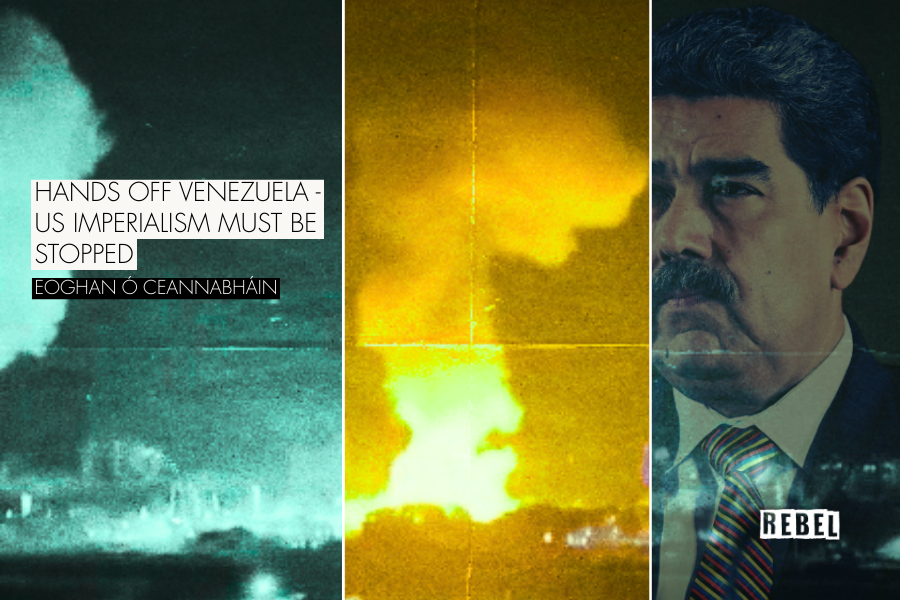
The assault by the United States on Venezuela, culminating in the bombing of Caracas and the kidnapping of President Maduro and his wife, Cicilia Flores, is the latest indication that the facade of a “rules-based order” is well and truly over. The Trump administration has been bombing Venezuelan fishing boats since September and seizing oil tankers linked to the country in a major escalation of aggression. After his kidnapping on the weekend, President Maduro was brought before a US court on trumped up charges of “narco-terrorism”. He has no hope of getting a fair trial, as this has nothing to do with any kind of idea of a legal framework – this is a naked power grab by US imperialism.
While Trump has offered the lie that these attacks are part of a new “War on Drugs”, he has mostly been thoroughly transparent in his motivations, which are to do with asserting US dominance and preferential access to oil markets. Venezuela has the largest amounts of oil reserves in the ground in the entire world. Trump is now claiming that US oil companies could be “up and running” within 18 months, as he threatens new Acting President Delcy Rodríguez with a fate worse than Maduro’s if she refuses to cooperate.
Donroe Doctrine
At the same time, Trump is setting his sights elsewhere in Latin America. Asked if he would launch a similar operation against Colombia, Trump said, “sounds good to me” and described the Colombian President Gustavo Petro as a “sick man who likes making cocaine and selling it to the United States.” Of Mexico, he said “we’re gonna have to do something” about the drug cartels, and as for Cuba, he declared it “ready to fall".
All of this is part of a conscious nod to the 1823 Monroe Doctrine, which asserted that the US should act against any rival powers in the Americas and intervene wherever it liked to ensure it would be the dominant imperialist power in the region. The subsequent history of US imperialism in Latin America is long and bloody, including support for military coups, dictatorships and death squads.
And Trump wants to go further:
“The Monroe Doctrine is a big deal, but we’ve superseded it by a lot, by a real lot. They now call it the Donroe document. American dominance in the Western Hemisphere will never be questioned again.”
The rationale for the renewal and intensification of the Monroe Doctrine is the same thinking that is driving the vast majority of the Trump administration’s foreign policy: the fear that China might overtake the United States as the world’s leading superpower.
Back in October, Maduro had offered Trump a deal which would have given the United States a dominant stake in Venezuelan oil. However, this was not enough for Trump, who is aware that China and Russia have gained a foothold in Venezuela’s oil industry and wants them cut out entirely. The kidnapping of Maduro and the attempts to bully the Venezuelan government into submission are not just about a simple resource grab – it’s about driving any rival competitor out of what the US sees as its territory. It’s also about sending a message to other Latin American countries that they could be next if they do not toe the line.
European Appeasement
Trump’s kidnapping of Maduro has largely been met with the servile acquiescence of most of Europe’s leaders. As one, they reaffirmed their support for “the principles of international law” while refusing to say that the United States had broken international law. Vice-President of the EU Commission, Kaja Kallas, said that Maduro “lacks the legitimacy of a democratically elected president” and advocated for “a Venezuelan-led peaceful transition to democracy”, in a statement supported by 26 member states. French President Macron said that Venezuelan people “can only rejoice” over the fall of Maduro, before later saying he neither “supported nor approved” of Trump’s methods. British Prime Minister Keir Starmer repeatedly refused to say that the United States had broken international law, saying the situation was “complicated” and that it was “for the US to set out its justifications for the action it has taken”.
This is just the latest instance of EU and British hypocrisy and subservience to Trump. For two years, they have backed the US and Israel’s genocide in Gaza and are enthusiastically supporting the NATO militarisation drive. Trump, recognising that China is increasingly threatening the US’ position as the world’s leading superpower, wants the EU to take on more responsibility and “pull its weight” when it comes to “security”. The EU and Britain see their own imperialist interests as being tied to the leadership of the US and are therefore going along with his gangster-style imperialism.
Irish Government
Taoiseach Mícheál Martin was no less craven in his response to the kidnapping, saying that Maduro “did a lot of damage and was quite tyrannical in his approach and repressive as a leader.” Like the other EU leaders, he also stated the need for a “strong adherence to international rules-based order”, even as any inkling of these rules is smashed up before our eyes.
Martin’s hypocrisy is staggering. He has had nothing to say about the tyranny of Trump, who, apart from his imperialist aggression abroad, is cracking down on dissent at home and deploying ICE to round up and deport immigrants from the US.
Of course, this hypocrisy is nothing new. The Irish government is also complicit in the genocide in Gaza through its economic ties to Israel, through its refusal to prevent ammunition being flown through Ireland and through the US military’s use of Shannon Airport. Despite a sustained movement of pressure against it for over two years, the Irish government has not implemented a single sanction against Israel. It refuses to enact the Occupied Territories Bill because it is subservient to Washington and fears reprisals from the Trump administration if it takes action. It is no surprise, therefore, that Martin is uncritical of Trump’s latest act of aggression.
Maduro’s next court date will take place on St Patrick’s Day. Undoubtedly, Mícheál Martin will travel to Washington that week to present Trump with the usual bowl of shamrock. In the wake of over two years of genocide, the aggression against Venezuela, the threats to Colombia, Cuba, Greenland, Iran and Mexico, it will be a deeply shameful act for any politician to meet with Trump and his administration this March.
The roots of Venezuela’s crisis
Trump’s kidnapping of Nicolas Maduro means the head of the Venezuelan state is gone, but the state itself remains intact. Trump recognises that he cannot simply instate opposition leader María Corina Machado in Maduro’s place, despite her desperate attempts to curry favour with him by offering to give him the sham Nobel Peace Prize that she was awarded last year. He knows that “she doesn’t have the support, or the respect, within the country.” Moreover, he will remember the last time he tried to recognise an unelected opposition leader, Juan Guaidó, as president of Venezuela – this move fell flat on its face for the same reason.
Instead, he claims that Delcy Rodríguez, the now Acting President of Venezuela, will work with him, or have to work with him, to impose his wishes and open Venezuela up for full, exclusive imperialist exploitation by US oil companies. Rodríguez, in an extremely difficult position, has expressed willingness to negotiate and work “jointly” with the United States, but has also condemned the US attack on Venezuela and asserted the country’s right to use its own energy resources to “serve our own development”.
The Venezuelan Government is in a weakened position, not simply because of the kidnapping of the president, but because it is in a protracted crisis that is partly to do with imperialist economic warfare and partly to do with the political strategies of the Government itself.
Maduro’s predecessor, Hugo Chávez, came to power in 1999 on the back of a radical programme of redistribution and participatory democracy. The United States collaborated with the Venezuelan right-wing opposition to oust him in a coup in 2002 – this was short-lived as the Venezuelan masses marched on the presidential palace demanding that he and his government be put back in power.[mfn]The 2003 documentary, The Revolution Will Not Be Televised, documents these events.[/mfn] Chávez redistributed the profits from Venezuela’s oil, investing in social programmes that dramatically improved life for Venezuela’s poor. Extreme poverty rates fell from 23.4% in 1999 to as low as 8.5% in 2011. Dramatic improvements were also seen in healthcare, education, working hours and pay.
However, Chávez’s reforms did not move beyond wealth redistribution and did not fundamentally challenge the capitalist system in Venezuela. He did not uproot the power of the ultra-wealthy in Venezuela, who maintained control of large parts of the economy, particularly the importation of food. His government struggled to diversify the economy away from oil. A bureaucracy also emerged in the chavista state, which pretended to support Chávez but thwarted the efforts of peasants who wanted to seize land and workers who sought to take control of their own factories.
The death of Chávez in 2013 coincided with a plummeting of oil prices, which the Government was ill-equipped to deal with as it remained so reliant on oil. The US compounded these difficulties with a sanctions regime that was initiated by Obama in 2015 and intensified by Trump in 2017.
Under severe economic and political pressure, Maduro’s government rolled back on many of the gains that were achieved under Chávez and implemented many neoliberal reforms. It began cutting social programmes, laying off workers and privatising state-owned companies. It created joint ventures through mergers with foreign capital as a means of “de-facto privatisation”, giving more power to Chinese companies in mining and gas extraction. As chavismo’s working-class base suffered from the hyperinflation that destroyed their living standards, the Maduro government relied not on the working class, but on the armed forces, which had special privileges.
What next for Venezuela?
The result of all this is that support for chavismo has weakened among the working class. This does not mean that they support Trump’s action however – a large majority of people in Venezuela oppose US intervention in their country. It was the Venezuelan masses that mobilised to put Chávez back in power after the 2002 coup, and these people could be galvanised again by the threat of further attacks from US imperialism and the Venezuelan right.
Before his death, Chávez himself argued that it was the power of the masses that could go be mobilised to go beyond a simple redistribution of wealth and mount a serious challenge to capitalism:
“We shouldn’t let ourselves be deceived: the social and economic system that still prevails in Venezuela is a capitalist and rentier system. [...] In order to move towards socialism, we need a people’s power capable of disarticulating the oppression, exploitation and domination plots that still exist in Venezuelan society.”
Ultimately, this was not achieved under Chávez as his government never broke from the logic of the capitalist market. Under Maduro, many of the gains made under Chávez were lost as bureaucratisation intensified and led to ever greater social control by technocratic and bureaucratic functionaries. At this point, the hope for a rekindling of the best parts of the spirit of chavismo lie not with the state, but with the masses.
This will be even more difficult if Trump manages to impose his will on Venezuela and turn it into a vassal state of the United States, however. The focus for those of us in the Western sphere of influence must therefore be to build a global movement of solidarity against imperialism, against further US intervention in Latin America, against its support for Israel’s genocide, and against our own governments’ complicity in these war crimes.
Practically that means organising an anti-war movement which can challenge our leaders at home, building pressure on them to break from slavish tailing of US imperialism, in order to undermine it. The global Palestine movement proved how masses can be mobilised and the power of that solidarity must be urgently directed to a broad anti-imperialist and anti-war footing with clear demands that can unite as many people as possible:Hands off Venezuela. No support for US imperialist ventures. No subservience to war criminals.
[1] The 2003 documentary, The Revolution Will Not Be Televised, documents these events.