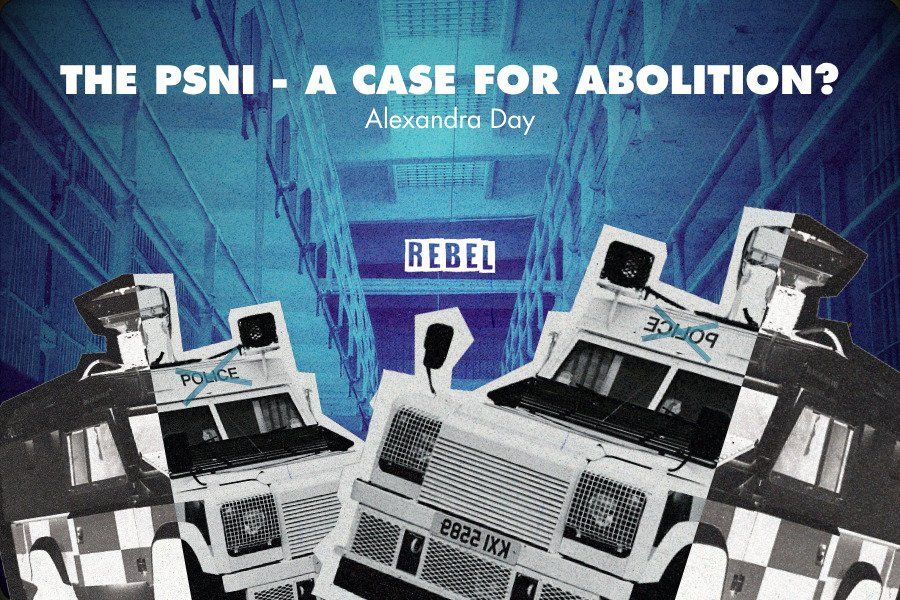
The PSNI - a case for abolition?
Public faith in the criminal justice system has hit an all-time low. Behind the comforting illusion of "law and order" lies a policing apparatus steeped in racism, pervasive sexism, and entrenched sectarianism. Our "justice" system rests on a blatantly two-tiered system where the rich and powerful are quietly shielded and let off the hook, while working-class and marginalised communities are heavily surveilled, brutalised, and relentlessly dragged through the courts. We are conditioned to believe these institutions are the bedrock of a functioning society, but all available evidence points to a darker reality, and many are coming to this realisation.
In recent years there has been a renewed conversation about abolition - not only of prisons but of policing itself, and about what we actually mean when we talk about safety. Abolition begins with some basic but indisputable observations: the police do not keep us safe; prisons do not deter men from murdering women; and the entire justice system privileges wealth and power. Abolitionist thinking is often associated with the United States, where it gained renewed visibility during the Black Lives Matter movement, and continues to shape organising today, particularly in resistance to ICE deportations. To understand why these systems fail us, we must look at what abolition actually proposes, and address some of the objections to it.
For many people, abolition sounds too abstract, utopian even. One of the most confronting entry points into the topic is the issue of sexual violence. Especially in the wake of tragedies, such as the murder of young women, it is common to hear a desire for more visible policing; a belief that an increased Garda or PSNI presence would translate into greater safety. Those feelings are real, especially in the working-class communities simultaneously most affected by such violence, but also by the highest levels of policing. These responses cannot be dismissed in our analysis.
To find ways of envisioning something beyond a reliance on these institutions, we must understand their origins, particularly here at home. Policing across capitalist societies has always been the ultimate instrument of class rule. In the Irish context, its failures, particularly regarding the PSNI, but also in different ways with the Gardaí in the South, there are clear examples that can be drawn upon from our own experience, which offer a different vantage point on questions of policing.
Policing under capitalism
To understand the criminal justice system from a socialist perspective, we first have to look at what the "state" actually is. We are often taught that the government and its institutions act as neutral referees, keeping the peace and serving everyone equally. But the state is a crucial instrument of class rule. In a capitalist society, the state exists to defend, secure and perpetuate the power and wealth of the ruling class - the capitalists who own the businesses, land, and resources - while providing a system of repression and punishment for the working class. The state, therefore, is not an impartial peacemaker, but an apparatus used by one class to maintain dominance over another.
Within this system, Lenin famously described the police and the military as "special bodies of armed men." Their primary function is not to solve everyday disputes or keep ordinary people safe, but to enforce laws that protect private property and capitalist interests. While police might also be required to intervene in interpersonal crimes, their structural role is to defend the capitalist status quo. If the core of capitalism is exploitation of workers for the accumulation of capital, the hoarding of wealth by a few at the expense of the many, the police are the physical force deployed to make sure that deeply unequal arrangement is not threatened by the people suffering under it.
This dynamic becomes glaringly obvious during moments of economic crisis or organised resistance. When workers form a picket line to demand a living wage, when communities protest against skyrocketing rent, or when marginalised groups rise up against systemic injustice, the police are consistently sent in to restore "order." Consequently, the criminal justice system ends up managing the brutal side effects of capitalism, such as poverty, homelessness, and addiction, by criminalising working-class people rather than addressing the structural greed that creates those conditions in the first place.
Policing in Ireland
In Ireland, the class function of the police is particularly visible in the legacy of the Royal Irish Constabulary and the structures that followed it.
Long before the London Metropolitan Police existed, the British state used Ireland as a laboratory for colonial capitalism, establishing the armed, barracked "Peelers", named after Sir Robert Peel, in the early 19th century to crush agrarian working-class resistance. This force was never intended to mediate local disputes or protect ordinary citizens. From the 1830s, ‘peelers’ were notoriously known for fighting any working class person who challenged the extremes of early industrialisation. In Ireland, it was also a paramilitary force to secure the private property of the Anglo-Irish landlord class.
During the Tithe War of the 1830s, Peelers were deployed to violently extract wealth from impoverished Catholic tenant farmers; during the Great Famine, police detachments stood guard at docks to ensure the uninterrupted, profitable export of Irish grain and livestock while the surrounding population starved. Decades later, during the Land War, the RIC served as the frontline shock troops for absentee landlords, regularly escorting bailiffs and actively participating in the mass eviction of families using battering rams. By functioning explicitly as the physical force necessary to uphold extreme wealth inequality and land monopolies, these early forces embedded a deeply coercive DNA, policing as the defence of elite property against working and class interest. This was never erased by partition, but instead became the foundational blueprint for the state forces that followed on both sides of the border.
Policing in Ireland took the form of defending colonial privilege and power shaped by colonial priorities, and that legacy continues to inform its present operation. Techniques developed under British rule in Ireland were exported elsewhere in the empire, including to Palestine, where members of forces such as the Black and Tans and the Auxiliary Division were recruited into the Palestine Police Force. What emerges from this history is a picture of policing as part of a global system of control rather than a neutral service designed for public safety.
PSNI: A reformed police?
Few but a handful of nostalgic unionists deny that policing in the North of Ireland has been a problem. For decades, the Royal Ulster Constabulary (RUC) operated not as a conventional police service, but as the heavily armed paramilitary wing of a sectarian "Orange State". Its mandate was never universal public safety; it was the maintenance of unionist dominance and the systemic subjugation of the Catholic working class.
When civil rights marchers took to the streets in 1968 to demand basic democratic rights, like fair housing and an end to gerrymandering, the RUC responded by baton-charging and bloodily battering peaceful protesters off the streets of Derry. The nakedly repressive nature of this apparatus was laid bare during internment in 1971, when the RUC kicked in doors across nationalist areas, dragging Catholics from their beds to be caged without trial, while loyalist paramilitaries were systematically ignored. Backed by the notorious, exclusively Protestant B-Specials, the force ruled through the deployment of plastic bullets, riot squads, and heavily fortified barracks, ensuring that for the marginalised Catholic population, the law was never a shield, but a weapon of state terror.
Defenders of the current system argue that while policing has a dark past, modern institutions have been thoroughly reformed. In the North, the transition from the RUC to the PSNI is often presented as a turning point that resolved the sectarian nature of policing. This reform agenda was heavily promoted by Sinn Féin, but now defenders of it, even in mainstream nationalism, are hard to find. Arrest and custody data continue to reflect sectarian disparities. Analysis of prosecutions reveals significantly higher rates of action against republican displays compared with loyalist paramilitary ones, with a ratio of 83 to 11 over a ten-year period respectively. In 2022, 62% of Justice and Security Act (JSA) stop and search cases recorded were of Catholics, compared to 33% Protestant. A five-year review found that nearly double the number of Catholics were arrested and charged compared to Protestants. Catholic recruitment to the PSNI has fallen to a trickle.
Sam McBride quotes from the experience of one of the first Catholic recruits to the "reformed" PSNI, who has since resigned due to sectarianism in the force:
“I had a raft of experiences of sectarianism within the PSNI — more so within the tactical support group, which is a predominantly male group… For instance, Ash Wednesday. I remember coming in with ashes on my head and the boys muttering under their breath saying ‘who the f**k does he think he is coming in with ash on his head?’
“I was hearing boys saying ‘Fenian b******s, who do they think they are?’ When certain politicians came on the TV from the green side, they’d be chastised and sworn at. There were boys whistling The Sash going up and down the corridors around the Twelfth… I could go to the inspector but he’d just pull these people all in and then I’ll maybe be with these boys in a riot line in a couple of hours.”
Racism and the PSNI
This stark disparity in community background is not incidental, but speaks to the real function of the police in the North, and is now affecting other oppressed communities too.
Sectarianism is not the only failing of the PSNI, therefore. Like its counterparts internationally, the "service" has become increasingly embroiled in controversy around its policing of migrant communities. It was recently revealed that the PSNI has shared data about tens of thousands of migrant victims and witnesses with immigration authorities, ultimately deterring crime reporting and amplifying fear. The number of recorded racist incidents has reached high levels in recent years, with 2,260 race-based incidents recorded in 2025 (an increase of 448 cases since 2024), illustrating both how pervasive racially motivated hostility has become, and the inadequacy of police responses.
The structural role of policing in the North must be understood in relation to sectarianism and class rule. Upholding order in the North means upholding economic and political hierarchies that privilege unionist and British state interests. Policing practices, including so-called ‘public order policing’, have historically been deployed in ways that secure the interests of the state and property-owning classes at the expense of working-class and nationalist communities. At the same time, communities facing the most acute inequalities have the least confidence that the police can deliver safety or justice for them. This underscores a cycle in which policing protects the status quo rather than transforms conditions of harm.
Institutionalised misogyny
Particularly in the wake of tragedies, the mainstream media is quick to argue that the solution to femicide and gender based violence is more police. By this logic, the police are supposed to "protect" women. There is little evidence they actually perform this function. In the North, official figures show that, since 2020, thirty women and girls have been killed by men, and dozens more were survivors of attempted murder or serious violence. This illustrates a persistently high level of gender-based violence that can only be called an emergency of violence against women. In March 2026, the killing of Amy Doherty, a mother of two from Derry, was reported as the 30th woman in the North to have been killed since 2020. Other women, such as Ellie Flanagan and Natalie McNally, have also been recent victims of murder, notably by their partners or men that were familiar to them. This terrible statistic is mirrored by similar figures in the South, where at least 32 women have been murdered in the same period.
These cases are not anomalies. In the North, domestic abuse makes up roughly one in five crimes reported to police. Survivors often report repeated failures in response from the police and from wider criminal justice institutions. These growing figures demand that we do not stop at mourning the lives of women needlessly cut short, but to organise and fight for a world where women can live without fear. The crocodile tears of establishment figures, such as Deputy First Minister Emma Little-Pengelly (who recently met and joked with the rapist Donald Trump), when women are murdered while they preside over the system of inequality that facilitates such violence, are an insult to the memory of victims and survivors.
We can, and must, do much more than challenge violence against women. Part of this must include not only addressing the root causes of such violence, but also highlighting how complicit the police are in upholding and perpetuating such violence. Presently, internal figures reveal that 134 PSNI officers are under investigation for sexual misconduct, accounting for almost a third of the most serious crimes reported more broadly. How can any person or community expect this same institution to protect them?
Concerns about differential treatment extend beyond policy into moments of outright violence. In June 2025, in Ballymena, what began as a ‘vigil’ over an alleged sexual assault escalated into prolonged anti-migrant violence, which police acknowledged as racially motivated and targeted at Roma families. Violence, in particular the burning out of community buildings, spread across the North in the week that followed. Hundreds of homes were attacked, including those of Polish people, Bulgarians, Filipinos, and Nigerians. A large portion of the local Roma community left the town in the aftermath, effectively displacing families amid a climate of intimidation and violence. The police did nothing to prevent these attacks, and minimal carceral terms were given to only a handful of individuals who incited and took part in what can only be described as a pogrom against the Roma community.
Prison discriminates
Sending the perpetrators of such violence to prison does not address the enduring damage and trauma done to communities and families in the wake of such violence. However, these cases are an exception. The majority of people imprisoned in Ireland, north and south, are not serving long sentences for serious violent offences, but short terms linked to poverty, addiction, or survival. These sentences are among the least effective in preventing ‘reoffending’, and tend to destabilise lives further. Loss of housing, work, and ties to the community brought by a prison sentence all make it more likely that people will return to the same conditions that led to their imprisonment.
Moreover, statistics have shown that Catholics have historically formed a higher proportion of the prison population compared to their percentage in the general population, with reports indicating they were almost twice more likely to be jailed and disciplined, often linked to factors like poverty. This demonstrates the same sectarian function of the prison system, like that of the police. Even when they are ‘working’, prisons do little to prevent violence against women, with carceral sentences for such acts already rare. Prisons intervene after harm has already occurred, and do not address the patterns of coercive control or the broader social conditions that enable abuse. As in policing, this leaves fundamental questions about what exactly the system is preventing.
Community alternatives?
If reform has failed and the system continues to perpetuate harm, we must ask what comes next. Abolitionist thinking does not ignore these realities, or suggest that harm can be wished away. Rather, it asks what kinds of responses are required to address the root causes of harm, and what forms of safety emerge when communities organise collectively rather than relying on institutions of coercion. Historical examples from Ireland, such as community organisation during the period of Free Derry, suggest that alternatives are not purely theoretical. This was a moment in a period of mass struggle when a community deliberately organised without the police, after decades of brutality and repression in the Bogside. Without formal policing, the community did not collapse into chaos. Instead, people organised collectively to defend their neighbourhoods, share resources, and respond to threats. One of the enduring images of this period is women alerting the community to army raids by banging bin lids in the streets. While imperfect and shaped by the pressures of the moment, these experiences demonstrate that communities can develop their own mechanisms for managing conflict and maintaining safety.
However, the history of “community-based solutions” in the North is more complex than a simple story of grassroots alternatives. During the ‘peace process’, forms of community patrols and restorative justice initiatives were promoted as alternatives to policing. While initially presented as community-led responses, many of these initiatives were gradually integrated into official policing frameworks and state funding structures. Over time, what began as alternatives often became mechanisms through which previously hostile communities were incorporated into the structures of policing and governance.
This tension forces an important distinction. Community self-organisation that emerges during periods of mass upheaval, such as Free Derry, the period of workers struggles after the first world war in Italy for example, or the eruption of popular representation in the Paris Commune, can form part of a wider process of developing dual power. These are alternative institutions that exist alongside and in opposition to the state. In moments of revolutionary upsurge, these structures can prefigure a different social order and point toward the possibility of a fundamentally transformed society.
In quieter periods, however, community initiatives can take on a very different character. Detached from mass movements, they are often professionalised, NGO-ised, and drawn into the wider network of organisations that sustain the modern state. Even when they formally sit outside police structures and may criticise them, they can become part of a broader civic infrastructure that stabilises existing social relations rather than transforming them. Similar dynamics can be seen in the history of community programmes within Black communities in the United States, many of which were initially radical but later absorbed into state-funded service provision.
Anti-capitalist Abolition
Recognising this distinction is essential. Abolition cannot be reduced to simply replacing police with community solutions in the abstract. Without wider social transformation, such solutions risk being reshaped into softer forms of social control. A community-based approach alone will not address the deeper structures at the heart of harm, namely a capitalist system that prioritises the wealth of a few over the needs of the many. If the goal is to prevent violence, particularly gender-based violence, the focus must shift towards the conditions that produce it.
Even where support services exist, the lack of access to safe housing forces many women to remain in abusive situations. The prohibitive cost of childcare reinforces this dynamic, as does the broader cost-of-living crisis. If people do not have the means to live secure and dignified lives, rising levels of violence and instability should not be surprising.
Meaningful action must prioritise resources for those in crisis while also transforming the social conditions that produce harm. This includes investment in housing, mental health services, addiction support, education, and genuinely collective forms of care. Violence is shaped by inequality, trauma, and instability, all of which require structural responses.
Abolition ultimately challenges the assumption that policing and prisons are necessary foundations of a safe society. Instead, it suggests they are part of a system that prioritises control over care and profit over human life. But what is required is a broader transformation of that system. In the Irish context, North and South, this is not an abstract debate. It is grounded in a long history of contested policing, persistent inequality, and repeated institutional failure. The task is not simply to imagine alternatives, but to build the social conditions that make them possible and to fight for a world in which safety is created through solidarity, equality, and collective care.