Reviewing 2025
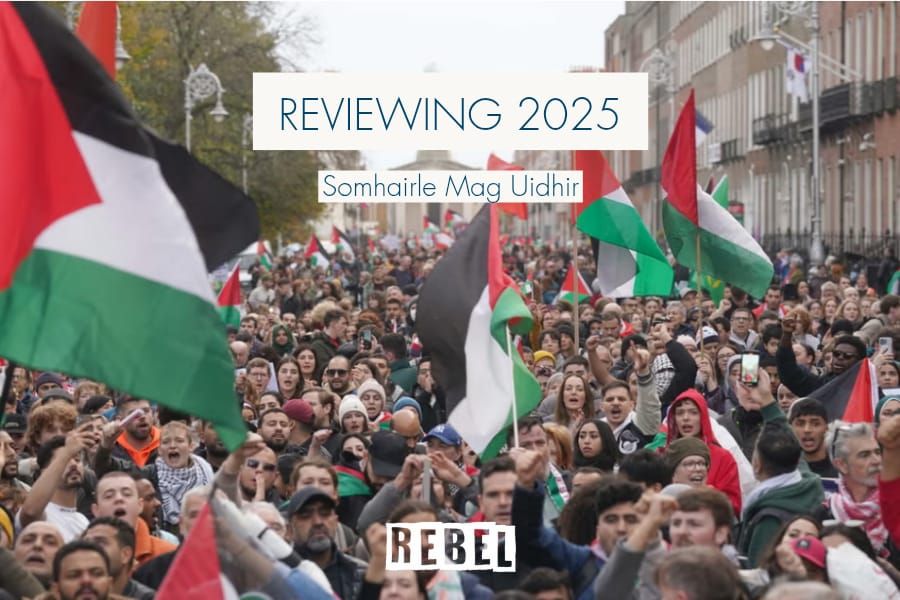
One yardstick of the magnitude of crises engulfing our planet is the increased difficulty in writing any sort of end-of-year reviews. Genocide, war, famine, social explosion – what a decade ago would have been year-defining events now jostle for adequate coverage. In 2025, history’s ghosts have come for us, competing for our attention with violent salvos and strategic lessons in unequal measure.
In an echo from the 20th century that the establishment media has done all it can to ignore, December saw a hunger strike by Palestine solidarity activists reach a critical stage. At the time of writing Teuta Hoxha and Kamran Ahmed have passed the Day 50 mark. Heba Muraisi is past Day 60. Their decision to have five demands – an end to prison censorship, an end to their illegal ‘remand’ status via immediate bail, a fair trial, the de-proscription of Palestine Action, and the shutting down of Elbit Systems in Britain – was born of both political conviction and a deliberate desire to connect with the Irish hunger strike of 1981.
The response of the British is telling and time-honoured: inaction as the hunger strikers’ condition deteriorated mirrored its paralysis as Israel continued to murder in Gaza; its commitment to mistreating and illegally holding these activists was a microcosm of its active cruelty towards Palestinians in the form of unwavering material support for Zionism.
It can be difficult to remember, amidst all the barbarity, that Israel’s standing was tested in 2025. Flotillas, general strikes and a global mass movement that, if not always coherent, has nevertheless remained remarkably persistent, combined to compel Western states to try to get Palestine off the headlines. A ‘ceasefire’ in name only was foisted upon Israel by a Western imperialism cognisant of the damage the unconstrained slaughter in Palestine was doing to ruling classes in their domestic backyards. As with every ‘agreement’ since the Nakba, the settler-colony is permitted to go about its business while Palestinians are told to acquiesce to their own eradication. Predictions should be avoided in such a turbulent world, but the continuation of Palestinian resistance is as certain as the West’s inability to account for it.
The horrific attack on Bondi Beach was a distressing confirmation of the real rise in antisemitism worldwide, driven by the far right, and of the propensity of establishment forces in weaponising it for their own ends. Predictably Israel used the mass shooting to denounce the global movement in solidarity with Palestine and were willingly followed by a host of Western leaders seeking to reheat tired conflations between antisemitism and anti-Zionism. The open fascists, meanwhile, followed their antisemitic diatribes with screeds of conspiracism and accusations of ‘false flags’. A small minority, radicalised by the experience of witnessing a western genocide in Palestine, risk being taken in by this ‘socialism of fools’ – a persistent ghost the left must ward against in the period ahead.
Marx once wrote of how class struggle in France ‘created circumstances and relationships that made it possible for a grotesque mediocrity to play a hero’s part’. And so again are grotesque mediocrities – Tommy Robinson and Farage in Britain, Katz in Chile, Charlie and later Erika Kirk, and a whole smorgasbord of other, interchangeable far right grifters – made possible by a stagnant capitalism whose economic vision is the accelerated plunder of people and planet in service to a combination of AI bubble and war-driven arms spending.
At the apex of this dystopian fusion is Trump with an administration locked in on reshaping the US ruling class during his second term. At home and abroad, MAGA has launched a shock-doctrine assault on Atlanticist liberalism, targeting social rights, institutional norms and the post-war alliances that have defined American hegemony for over half a century.
The legacy establishment has followed the expected historical pattern almost to a tee, shifting further and further right in response to far right momentum – witness Starmer exhuming Enoch Powell’s infamous ‘Rivers of Blood’ speech. The result of all this was similarly foreseeable: as the overton window moved right, far right parties achieved polling majorities or outright power in many countries, most notably in Europe and South America.
The exception that proved the rule, however, was the cleavage over Ukraine. European powers were sent into a tailspin by MAGA’s twin objectives of de-escalating the Russian threat with a view to pivoting to China, and bullying the EU into line. Cue a public dressing down in the Oval Office of the poster boy for European rearmament, Zelenskyy, and more recently a Trump-led ‘peace’ deal which hoovers up resources for the US while frustrating Europe's desired military conflict with Russia via Ukraine. But the drums of war beat on: Germany reintroduced conscription, French generals said young people must be ready to die, arms spending increased, and ordinary Ukrainians are but pawns on their chessboards. The Irish Government, ever the willing lapdog, is redoubling its effort to bin Irish neutrality and put us officially in the NATO camp.
If the ruling class is ‘a band of warring brothers,’ then in 2025 the emphasis definitively shifted to the adjective. Trump's scope has been global. Warhawks have been unleashed on Venezuela, which is receiving the Iraq playbook. The US bombed parts of Nigeria on Christmas Day. Sudan continues to be beset by war and famine, while the White House castigates Somalians with base racism. And Greenland was coveted much as how a Mar-a-Lago huckster might seek to muscle his neighbour out of their share of the nearby gated real estate.
Trump’s warmongering is in part a response to domestic crises, including an ever-worsening affordability emergency, yet none bigger for MAGA than the fallout over the Epstein files. The web of ruling class men centred on the notorious abuser and sex trafficker have been bravely challenged by some of the women they violated. Trump’s implication and subsequent effort to prevent the release of evidence has driven a real wedge in the MAGA project this year. The brutal unleashing of ICE on people of colour across the US is another reflection that Trumpism reins, though not securely.
Zohran Mamdani’s victory which rightly electrified the international left, is one case in point. His was a mass campaign, a disciplined working class message on economic issues, and a forthright challenge to racist and transphobic ideas and their right-wing purveyors. The result: a left-wing Muslim mayor was elected in the belly of the capitalist beast.
Debates abound as to how Mamdani can implement his agenda, and what approach the left should take to elected politicians if and when they waver from their commitments. Reform or revolution lives on then, not only in New York, but in Mexico where President Claudia Sheinbaum continues to poll well, and across the water where the radical left in the fledgling Your Party are butting heads with Britain's specific brand of ossified reformism, Labourism. Meanwhile Zac Polanski's rise shows the value of clear and principled communication for the left, but fraternal caution remains the order of the day: the overwhelming record of the European Green parties has been one of disastrous capitulation to capitalism. In an age of war, this is a particular historical ghoul whose reincarnation we can definitely do without.
How to respond to attacks on gender and race from a bullish right has continued to bedevil the left this year. Spectres of economism loom large. Success in pushing back the right, where we’ve seen it, has come from an agile application of special tactics to tackle the far right, specifically mass counters, in tandem with a resolute opposition to all forms of oppression and to the economic status-quo that is immiserating us all. This brand of distinctly revolutionary socialism was few and far between globally in 2025, but where aspects of it were even partially applied, it resonated.
Catherine Connolly's barnstorming victory was a welcome shot in the arm for the Irish left after a challenging few years. The success of the campaign, between parties broadly on the left, confirmed the pitch set out by socialists for years now: to grow, the left must rule out coalition with Fianna Fáil and Fine Gael, and mobilise on the ground. Principled unity, which holds the line on immigration especially, combined with the overarching goal of pulling ordinary people into action, is the order of the day.
Bláthú na teanga was another feature of the Connolly campaign, reflecting a real growth in the Irish language, itself a product of a wider re-engagement with Irish culture and our anti-colonial history. Kneecap are arguably the touchstone for this phenomenon – their activism on Palestine in tune with a wider political awakening caused by the West's genocide in Gaza. Mo Chara finding himself a target of Starmer's authoritarianism, alongside a host of other activists across Britain and in the North, provided an example to a younger generation of Irish people in the perfidy of the British state.
This shifting, cultural anti-colonialism extends beyond the Belfast and Derry trio. The success of Liadan Ní Chuinn's collection of short stories, Every One Still Here, cemented its arrival in the Irish literary scene for example, while Huartan's condemnation of capitalism as the system at fault for the world's ills on their debut album, and their call for a pagan opposition to it, encapsulates both the class and anti-imperial anger among young people today, and the extent to which people are rummaging round the bag of history for resources to resist.
This moment is not without its contradictions however – note Labour leader Ivana Bacik unironically claiming her party as a “Connollyite Republican party.” Irish history, Irish radicalism, is replete with heroic inspiration and demoralising sellout. In 2026, can we parse out what we should retain from that which should be cast off, especially when the primary obstacle is an Irish elite less under the threat of the British gun than it is enthusiastically wedded to the American dollar? As ever, what counts will be political deeds, not donned labels.
As another COP passed without a whimper, and our climate further careered into the abyss, Ecuador bucked the trend. A general strike, led by indigenous communities but including whole broader swathes of the country's working class, secured a rejection of viciously extractivist, neoliberal constitutional reforms and defended hard won environmental protections. With certain conceptions of indigeneity in vogue in many of our social movements, at times veering into fetishisation, Ecuador unearthed a priceless historical spirit: the tactics of workers’ power. Strikes, mass mobilisations, control over production, etc. remain the only way to really land defeats on a capitalist system intent on devouring planet, people, and all our myriad ways of life, old and new.
Mass industrial action rocked the South Korean establishment, while the Italian dockers brought the Palestine solidarity movement to a higher plane. Closer to home labour fightbacks were infrequent ; the school secretaries’ strike standing out for its militancy and the extent it threatened to draw in support from the wider school communities.
North of the border, Stormont rumbles on, though more precariously by the day. An increasingly belligerent Unionism trotted out ever more sectarian, racist and transphobic bile (the latter emboldened by a UK Supreme Court decision which undermined trans rights in Britain). Mainstream nationalism and Northern Irish liberalism again showed its impotence in response – indeed it took the only socialist MLA to raise an almighty stink over Education Minister Paul Givan’s propaganda junket to Israel before there was any potential of consequence for DUP impudence. Meanwhile over 30,000 people are reported to have died on a health waiting list over the last three years, no one can get a house, and the cost of living crisis seriously worsens.
It is a similarly bleak economic picture in the South. Fianna Fáil and Fine Gael returned to power, propped up by a host of self-interested quisling TDs. They’ve sought to ram through a raft of right-wing legislation, while Trump’s scattergun sanctions temporarily frightened the Irish elite’s tax haven gravy train. Despite a lack of organisational coherence, due in part to the uptick in concerted anti-racist mobilisations, the far right remains a threat. Their silence over the epidemic of femicide, North and South, is no surprise; their faux-concern for women belied by their celebration of Conor McGregor – the rapist whose appeal against Nikita Hand failed in July – as a potential president.
As expected, the far right’s anti-immigration agenda has been made more mainstream by the government. The worst of the lot is Jim O’Callaghan, the Justice Minister, who wants to clamber into the Fianna Fáil leadership position on the backs of racist deportations. And the government’s recent vote against Bríd Smith’s abortion bill – a u-turn on their part – was indicative of regression to another mean of Irish establishment politics: anti-woman, with one or more eyes on the wants of the Catholic Church. As mentioned, Catherine Connolly’s victory was a timely reminder that if we get our act together, this old devil will not have an easy comeback from history’s dustbin.
The past few years have arguably been defined by two related phenomena. On one hand, largely due to Gaza, there has been a qualitative increase in ‘good sense’ about how the world works, specifically of the barbarity of imperialism, its systemic nature, and the extent to which our rulers and institutions at home are complicit. On the other hand, movements have faced the difficult reality of running up against a stubborn capitalist system. This contradiction has led to great political leaps, alongside the rehabilitation of political strategies that had been cast off for good reason. For example, a healthy hatred for the evils of American imperialism is, in places, being filled by a crude and unconscious campism. Yet, James Connolly taught us long ago that the enemy of our enemy is not our friend, with his slogan ‘Neither King nor Kaiser’.
Why did Connolly, and others like him, disregard certain conclusions – such as that we would do well not to ally with another imperial block (Kaiser) in opposition to our oppressor (King) – and arrive at others: the only incorruptible inheritor to our freedom is the working class? Of course, we can’t expect anyone to know every single lesson of the past, of every scheme and experiment tested by revolutionary movements, every obstacle and counter-offensive thrown in their way. But to progress beyond conscious anger at the state of the world mixed with confusion as to how to tackle it, we should try to learn as many of them as possible.
How best to do this? The Hungarian Marxist Gyorgy Lukacs wrote that “organisation is the form of mediation between theory and practice”. In other words, how we organise ourselves is the critical link in bridging the gap between our abstract ideas about how society works and our often spontaneous action which tries to change it. No sustained political organisation – a political party – means no shared, long-lasting and nation-wide space for assessing our tactics and strategies, for fusing hard-won political experience with necessary creative initiative, or for being able to help build broad movements while retaining necessary principle and clarity. In 2026, this conclusion is one historical ghost we should heed.