People Power Can Force Corporate GAA to Drop Allianz
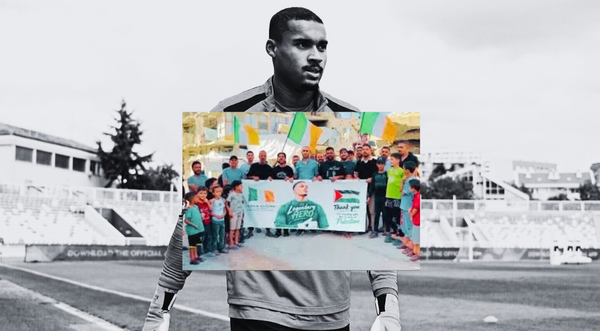
Last July, Motaz Sassour GAA club, based in Ramallah, were due to travel to Ireland in an exchange backed by GAA members and players who have consistently helped support the club since 2023. They were supposed to do a tour of the country, visiting Thurles, Páirc Uí Chaoimh as well as a guided tour of Croke Park by GAA President Jarlath Burns, but their temporary visas were refused by Jim O’Callaghan and the Immigration department.
The club released a statement reflecting that they are “used to our dreams colliding with the walls of politics”.
Since July, a member of Palestine GAA, Muhammad, has been incarcerated by the IDF. In the process of arrest, he was blindfolded, dragged into an armoured car and taken to Beitunia prison, sustaining broken bones. Muhammad is 15. Another member of the club has been killed. In total, Israel has murdered over 400 athletes and at least 18,000 children since the beginning of this genocide.
Military abductions, institutional violence, and apartheid are not cheap enterprises, and the system that produces this kind of society is extensive and reaches across the globe, with the backing of corporations and governments the world over. The apartheid system would not survive without consistent funding and investment from different private corporations. One such company is Allianz, which holds over 1 billion dollars in Israeli war bonds, and has $7.3 billion invested in companies implicated in the Israeli economy.
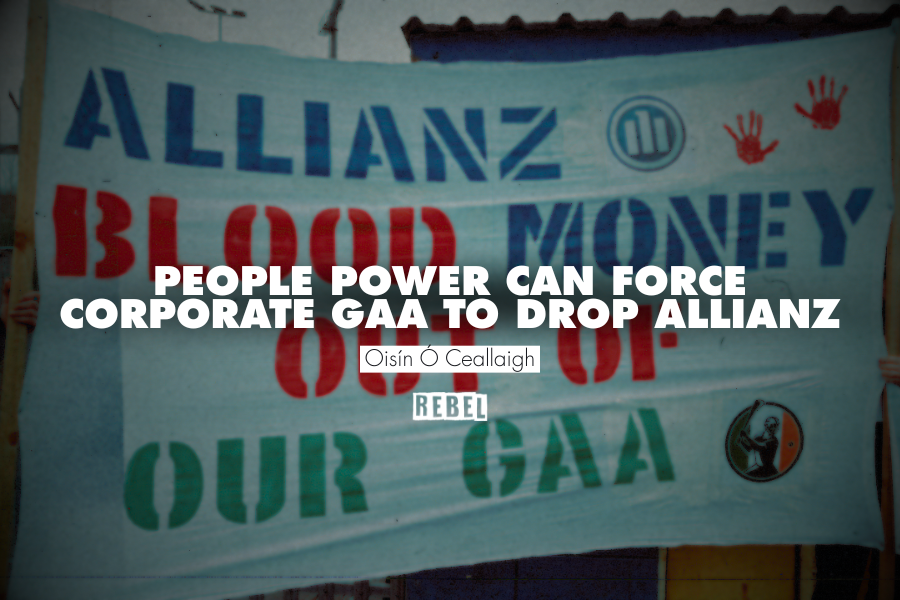
Allianz sponsors the second biggest competition in the GAA calendar: the National Leagues. It has done so for many years without much issue, until Gaels Against Genocide and many ordinary GAA members started to question whether this was an appropriate relationship for an Association that prides itself on its values.
The campaign
In 2025, UN Special Rapporteur for the Occupied Territories, Francesca Albenese, was among those who published the UN report condemning Allianz for their continued investment in Israeli bonds and technologies. Following the report, grassroots GAA members began to organise around the call to drop Allianz as a sponsor. An open letter was subsequently signed by 800 current and former players directed at the GAA, including Neil McManus, Kieran Duff, Colm O’Rourke and other current and former intercounty players urging them to cut ties with the insurance company.
In response the GAA commissioned an internal report from its Ethics and Integrity Commission. It argued, spuriously, that the Irish subsidiary (Allianz plc) is not involved in the genocide in Gaza, despite funneling its profits to the German parent company singled out by Albanese.
An Coiste Bainistíochta, the GAA’s highest management committee, accepted the findings of this report, ignoring in the process the resignations of 1/3rd of the Ethics and Integrity Commission over the deal.
Jarlath Burns’ reaction to the issue was disappointing to say the least. On his appointment as President, expectations were that this was a man from South Armagh, understanding of the imbalances within the GAA, and the legacy of conflict in the North, who ‘knows right from wrong’. Replying to the point that almost 800 prominent GAA figures have signed an open letter asking the organisation to end its relationship with Allianz, he said, “800 might seem a lot. In the vast scheme of things, it’s 0.13% of our membership.” This is a neat avoidance of the fact that the 800 are made up of only current and former intercounty players. How many of the total membership, if polled, would agree with those 800?
Burns has in many ways made an important mark since becoming President, releasing a statement in support of the Palestinian people and even using his speech after the All-Ireland Hurling final to defend immigration. But the inconsistency between these progressive comments on social issues compared to his obfuscation on the issue of sponsorship generally reflects a growing disparity between a GAA which is incredibly corporatised and unrelenting when it comes to defending financial interests over the welfare of the membership.
The player end of the campaign has stepped-up during the opening rounds of the Allianz Gaelic football and Hurling leagues. Pre-match and Player of the Match interviews have been taken in front of blank walls, substituting the typical Allianz branding. Match day programmes were void of any Allianz branding. At Celtic Park, where Derry hosted Tyrone, as well as at Cushendall and the Athletic Grounds at Armagh, protests were held, led by current and former county players. Players and campaigners have stressed that these protests will not subside any time soon while the issue lies undealt with.
On an official level, ten county boards, including Armagh, oppose Allianz’s sponsorship of the league, and the threat of boycott has become a real possibility. Damian O’Hagan, Tyrone legend and a member of the Gaels Against Genocide campaign group, said the decision taken by the GAA top brass is “completely out of touch” with the sporting organisation’s grassroots members.
The truth of this can be seen in central GAA’s decision to block a motion promoted by those same ten county boards onto the Annual Congress Clár – a real cause for concern and emblematic of a serious democratic deficit within the organisation. Playing Rules changes are allowed to be tabled, but concerns about sponsorship and financial interest apparently are not.
Regardless of the top brass of the GAA’s perspective on Allianz as a sponsor, taking the decision out of the hands of the general membership should prompt discussion over the increasing alienation between the everyday volunteerism and community-led structure of the club game, and the corporate side of things, which refuses to turn down a profit even at the expense of alienating their membership.
Why the GAA doesn’t want to give up Allianz
In a way, the current Allianz protest is part of a larger analysis of the GAA as having become an increasingly commercialised body. Controversies over streaming rights, player welfare, uneven development among counties, gate ticket prices have permeated for years. A trip to Croker would hardly be complete without someone giving out about the “Grab-all-association”. Commercialisation took root in the 1990s, as Ireland moved towards globalisation, and the Celtic Tiger had a profound effect on expenditure within the organisation. Allianz itself began sponsoring the league in 1991, with a deal that is currently set to last until 2030.
The GAA’s response to the call to drop Allianz emphasised commercial ‘risks’. It fears that losing it as a sponsor would make the association “toxic” to other potential sponsors. They proclaimed that they were contractually obligated to maintain their relationship with Allianz, and that Allianz Ireland has “no connection to the parent company Allianz”. Pundits like Colm O’Rourke have objected to the claim that the GAA would be hard pressed finding another sponsor, and stressed that sponsorship would not dictate the quality of the game if the league were to go without it for a season.
Unfortunately, the extent of the commodification of the upper echelons of the GAA is such that commercial interests like this can outweigh a fundamental human principle of not wanting to have anything to do with genocide. That this is even a matter of debate, that Allianz weren’t proudly dropped as a sponsor, speaks volumes to the state of things.
Player Power
The drastic changes in the economic model of the GAA coincided with a revolution in the sport itself, spurred by a redefinition of what it meant to be a GAA athlete. From the mid-90s on, Gaelic Games demanded more sacrifice from players than ever before: 30+ hours a week on top of professional careers and personal lives was what was required to compete at the level we see today.
The wave of intensity that arose out of Ger Loughnane’s Crusheen sessions, and the economic wave that swept up the GAA into the world of global capital has undoubtedly landed the sport into a frontier of skill and athleticism unseen previously. This has translated into viewership and attendance numbers; the record for league game attendance was broken in Pairc Uí Caoimh for the recent Tipperary v Cork game at just under 31,000.
In the modern history of the GAA, it has typically been up to players to demand better from the central committee. Cork in 2002 made their claims very clear: players weren’t compensated by county boards for the amount of effort being put into training. Camógs in 2024 demanded a shift away from skorts to a more dignified uniform which upset the conservative element of the sport, as part of a wider call for more respect in an organisation where they have been second fiddle to men's teams in regards to pitch time and other resources.
With player power having played such an essential role in shaping the current GAA landscape, it is vitally important that the current challenge to Allianz has widespread support among active and former players.
A return to the real spirit of the GAA
Late weekend nights in clubhouses, especially in the North, are typically buzzing with reflections on Féile glories, minor highs and lows, and ‘could have beens’ whose careers were shortened by injury or the drink. As those nights stretch into the morning, sombre reflections are sometimes made by older managers or members about players – often relations or very close friends – who were lost to the violence of the struggle and to state violence. Stories of people whose memory endure through hazy faces on old team photographs or their names engraved onto dusty shields and cups.
This is the modern legacy of imperialism within the GAA: an endurance of historical memory and cross-generational trauma that propels so much of the player base to demand that everything is done to maintain ethics within the association, and to sever any links between the GAA and Israel, in the hope of not being responsible for fomenting that same pain among Palestinian communities.
Speaking years ago about his experience of being harassed at checkpoints on the way to training during the troubles, former Down footballer Conor Deegan reflected:
“In the great scheme of things, you look at what’s happening (to) Palestinians, what we went through was Mickey Mouse stuff really. But it was largely there to antagonise, and upset and annoy. It was always about that antagonism. It was, ‘We can do this and that’s the way it’s going to be.’”Forcing Irish institutions to divest is the paramount way that we can actively support people suffering on the ground in Gaza, and take a stand for the hundreds of thousands already killed. For all the flag-waving and words of condemnation spouted by the Irish government, materially we have not done much more than any other government in terms of nullifying Israel’s influence abroad. Boycotting Israel creates a precedent that genocide, imperialism, land theft won’t be accepted, morally or financially. If the globalised world of capital thinks it can separate itself from the political machinations of Israel’s colonisation campaign, it has to be people on the ground that prove it wrong, by shutting off their sources of revenue.
The movement against Allianz from within the GAA is based around the association’s founding principles: volunteerism, mass participation and democracy. Players, dedicating their lives to the games, see the work of managers and selfless volunteers who implement these values more than anyone, and the calls from within to divest from Allianz come from these principles, and the wish to see them applied regardless of profit.