How the grassroots uprising in Iran has turned into a far-right misogynist spectacle in the diaspora
As people inside Iran grapple with the despair and collective trauma of the January massacre of the protesters and the waves of arrests and executions, the scale of state violence has become increasingly clear. At the time of writing, according to Human Rights Activists in Iran (HRANA), the total number of confirmed killed stands at 6964 across over 200 cities, and more than fifty thousand have been arrested, many of them children and students.
In an act of solidarity and to pressure Western democracies to respond to these atrocities, many Iranians in the diaspora have organised weekly demonstrations. These protests have been particularly large and visible in countries with long-established Iranian immigrant communities, such as Germany, France, and the United Kingdom.
However, many of these diasporic expressions of dissent against the Islamic Republic project a reductive image of Iran that erases the country’s diversity of opinions. The Iranian state itself is an authoritarian theocracy advancing a hardline far-right agenda, which prioritises the Ummah's interests over its people. Ironically, the most vocal segment of the diasporic protests in this current uprising also follows a far-right logic that excludes multiplicity of oppositional groups, silences minorities, and reproduces the language of hate and extermination, treating the people of Iran as the king’s subjects (ra'iyat) instead of citizens.
Flag of the old regime, inside and outside Iran
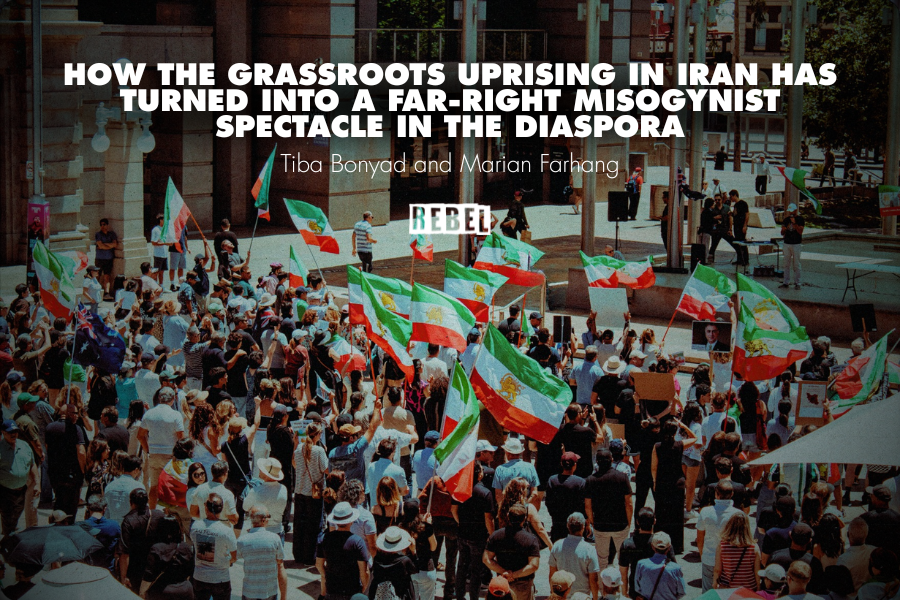
One of the central symbols of these protests is Iran’s flag. The current flag of the Islamic Republic holds no credibility among the state’s diverse opponents and dissidents. Yet the question of what should be waved and displayed at diasporic demonstrations has itself become a battleground. In the diaspora, the flag’s symbolic function has shifted from a solidarity standpoint to a trope of exclusionary identity politics closely aligned with white supremacy.
As images from these demonstrations circulate, they reveal protests overwhelmingly adorned with dramatic banner-style Shir-o Khorshid (Lion and Sun) flags. The supporters of this flag assume a great historical past for Iran that was stolen by the 1979 revolution. It should also be noted that some Iranians who wave this flag do not necessarily sympathise with the monarchists; rather, they consider it a symbol of historic Iran.
The Lion and Sun symbols on this flag are associated with the Pahlavi dynasty, whose exiled crown prince, Reza Pahlavi, is now regarded by many Iranians (both inside and outside the country) as the leading figure of the opposition. His position has been further amplified outside Iran through years of support from hegemonic media outlets and satellite television channels, such as Iran International and Manoto (both based in the UK). These have actively promoted the return of the monarchy and lately the necessity of war as a liberation mission. Furthermore, there are investigative reports which point to a covert Israeli‑based digital‑influence operation that uses fake social‑media accounts and AI‑generated content in Persian to promote Reza Pahlavi, the son of the last Iranian shah, and which amplify calls for reinstating the monarchy in Iran.
Inside Iran, the story is different. More than four decades of propaganda, slogans and deliberate erosion of historical memories have reshaped political understanding. The alluring nostalgic videos of the Pahlavi era on these satellite channels deformed history as emotional longing for a lost era of glory and order, with no mention of repressions and contradictions that defined it. Many watch this nostalgic, wistful image of the past to confront the harsh reality of life under the Islamic Republic: a neoliberal authoritarian theocracy, marked by political and social repression, widespread poverty, systemic gender oppression, and environmental catastrophe. Under these conditions, the imprisonment of the majority of activists and members of the political opposition has undoubtedly reshaped and strengthened the appeal of monarchism for some. However, this is only one political vision among many. Alternatives ranging from a secular republic to democratic governance models, as well as other forms of monarchy, such as a constitutional monarchy, continue to generate significant debate inside Iran.
Far-right supremacism
In recent protests in diaspora, however, the flag has increasingly become the primary signifier of the monarchist movement in general, and of its far-right factions in particular. This shift became especially visible during pro-Israel rallies after October 7 and throughout the genocide of Palestinians, where Lion and Sun flags were frequently waved alongside Israeli ones. In the current wave of demonstrations, the flag’s dominance has turned it into a marker of organisational control. Its function now resembles that of the St George’s Cross in the UK, when used by anti-immigration protesters as a symbol of supremacist patriotism that excludes those who do not identify with it.
Numerous reports and viral videos show other protesters being beaten, verbally abused, threatened or barred from demonstrations for carrying alternative flags, such as the Kurdistan flag, representing one of Iran’s historically marginalised minorities, or the Woman, Life, Freedom flag. Paradoxically, while bearers of these symbols are accused of separatism or ideological deviation, Israel flags, or hybrid displays combining Israel and Lion and Sun flags, as well as US flags, are welcomed within these same protests. As absurd as these flag disputes may appear, they convey a clear message. In the name of Ettehad (unity), any voice, disagreement, or political imagination that does not envision Iran’s future as a monarchy has to be silenced.
Discursive violence and the language of hate
The language of hate and harassment is a defining feature of these diasporic protests, manifested both in repeated chants and in mob-like encounters. This hostile rhetoric often operates through explicitly misogynistic and homophobic discourses. In a video circulating from a protest, a young woman carrying a Woman, Life, Freedom flag is aggressively confronted by monarchist supporters for her choice of symbols. When she calmly explains that she is there to stand shoulder to shoulder with the monarchists against the Islamic Republic, she is met with ridicule and abuse, and is called “Woman, whore, freedom.”
Rather than claiming justice for the thousands of peaceful protesters killed in Iran, many diasporic gatherings have devolved into ugly spectacles of far-right performances. At a rally in Vienna, one speaker shouted, “Wir sind die Perser” (“We are the Persians”), framing the protest as a celebration of ethnic superiority (in a historically multi-ethnic nation) and a longing for the return of a long-dead king.
In London, Shahkar Bineshpajouh, a well-known Iranian musician and monarchist activist, used explicitly vulgar homophobic language to demand that the next regime appoint him to oversee punishment. He called for Iranian authorities to be hanged “from their buttholes” on the trees of “Pahlavi Street” in Tehran.
Such rhetoric does not call for justice, but for the continuation of the circle of violence and repression: today by the current state, tomorrow by the monarchists. Instead of demanding the downfall of the Islamic Republic through transitional justice, legal accountability, and collective repair, these voices ask for the death of anyone who opposes them, irrespective of their proximity to the current Iranian state.
Far right monarchists openly articulate their exclusionary ideologies through chants such as “Death to the three corrupt ones: the mullah, the leftist, and the mujahid.” As these three mentioned groups formed the main opposition to the Pahlavi dynasty before the revolution, the far-right monarchists seek revenge against those who participated in the 1979 revolution. Promoting this slogan, Reza Pahlavi’s consultants openly call for the inauguration of the Khavaran cemetery in each province of Iran. This group is reproducing the very logic of repression deployed by the Islamic Republic, most notably the embrace of the death penalty.
Demand for a war as diaspora politics
The plans and political agendas of monarchist activists in the diaspora are largely organised around a vague and deferred vision of the ‘day after’ regime change. While recently they started to frame the people’s uprisings as the national revolution, for years, what they have been advocating was regime change through encouraging sanctions on the Iranian people and lately, military intervention, as they do not believe in people’s power and their organised movements. More importantly, they do not intend to fundamentally transform and dismantle the underlying unjust order of the current political system, which operates in favour of certain factions of the government’s supporters and oligarchs. This, in fact, reveals that their conception of change is strikingly passive. It presumes that people inside Iran will continue protesting tirelessly, absorbing bullets and live ammunition, until the Islamic Republic collapses.
Many of these diasporic activists openly call for Israel and the United States to bomb Iran, advancing a dangerously naïve belief that war would somehow end the regime while civilians would be miraculously spared. Positioning themselves as an exceptional nation, these factions appear unwilling to learn from the recent history of US military operations in Venezuela, or from the decades of war and devastation inflicted on neighbouring Iraq and Afghanistan. By disregarding the fact that Iran is located between Afghanistan and Iraq, they depict US military intervention in Germany and Japan as successful examples of military intervention leading to economic prosperity and democratic stability in these countries. In this wishful thinking about military intervention, there is no room for the discussion of casualties and the human toll of war.
At demonstrations outside Iran, banners and chants frequently call for US jets and for bombs to rain down on Iran. At a recent protest in London, one banner read: ‘President Trump and Prime Minister Netanyahu – Act Now. Protect Iranian Lives. Secure Peace.’ The irony of invoking war as a path to protection and peace went entirely unacknowledged. Another placard declared, ‘Make Iran Great Again.’ In this MIGA imagination, ‘greatness’ is achievable only through imperial military intervention that would clear the path for a king to return and rule. Within this war-driven fervour, any criticism of military intervention by Israel or the US is immediately dismissed as pro-regime apologism. There is an increasingly concerning anti-intellectual strain to this movement whereby any critical thinking, any calls for inclusion or plural visions for Iran’s future are met with intimidation or silencing, similar to the global far-right rhetoric.
Within Iran, united in resistance
This stands in stark contrast to the realities inside Iran. During the protests and in their aftermath, accounts emerging from within the country described a society devastated by repression, but united in resistance. Millions took to the streets with a single demand: the fall of the Islamic Republic. In the face of live gunfire, people held hands without questioning one another’s political affiliations. Women’s rights activists and labour organisers, as well as ethnic minorities, including Kurds, Baluchis, and Turks, many of whom do not support monarchism, were at the forefront of the uprising. Even supporters of Pahlavi encountered inside Iran were notably receptive to dialogues, questions, and critiques - one explicitly stating “We did not grant Reza Pahlavi a signed blank cheque.” This cautious stance sharply diverges from diaspora rhetoric. The spectacle of exclusion based on fanaticism that is unfolding in parts of the diaspora bears little resemblance to the lived trauma, solidarity, and political plurality of those resisting the regime from within.
In recent years, in the aftermath of the Women, Life, Freedom movement, there has been a gradual distancing from a politics that cherishes and respects life. Inside Iran, the state responded to people’s grievances and protests with military bullets and harsh violence, treating people’s lives as disposable for the preservation of the status quo. Outside Iran, far-right monarchists demand US and Israeli bombs to liberate Iran, articulating people’s lives inside Iran as collateral damage for regime change. However, political dissidents and activists from different backgrounds, both inside and outside Iran, are refusing to animate the politics of death advocated by both the Islamic Republic and the far right monarchists. Despite the risks and dangers, they are calling for a third way, a democratic and peaceful transition of power, relying on people’s power.