Gender-based Violence, the Epstein Files and Capitalist Power
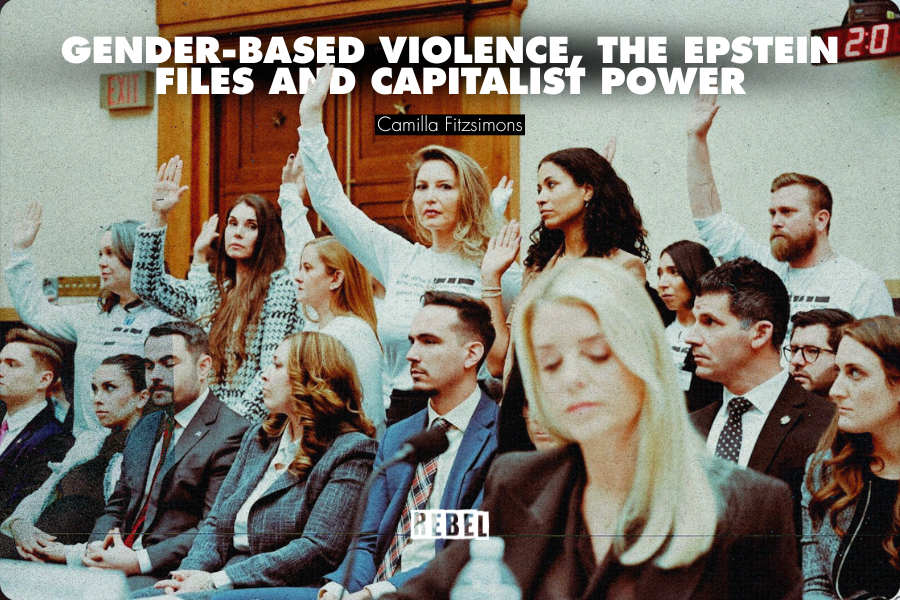
On 30 January, the United States Department of Justice (DOJ) released over 3 million pages of the so-called Epstein files in compliance with the Epstein Files Transparency Act, which was signed into law in November 2025 by Donald Trump, an associate of Jeffrey Epstein.
In total, around 3.5 million pages including photos and videos, witness testimonies, fight logs, wire taps, bank records and private correspondence have been released, all of which were gathered across criminal investigations into multiple cases of human trafficking that mostly involved teenage girls. Some analysts have suggested this mountain of evidence is just a fraction of the total files held by the DOJ.
In 2019, and at a time when he is thought to have been cooperating with authorities, Epstein reportedly died by suicide whilst awaiting trial for conspiracy and for trafficking minors. Two years later, Ghislaine Maxwell, his closest co-conspirator, was sentenced to 20 years in prison after she was found guilty of multiple crimes connected to the trafficking and abuse of children, the victim numbers of which reportedly ran into the thousands. In 2022, another co-conspirator by the name of Jean-Luc Brunel who managed the Epstein financed French modelling agency MC2 Model, also died by suicide and again whilst in custody awaiting trial.
Epstein also once served time in prison. In 2008, he pleaded guilty to two counts of paying for sex, one of which related to a child. This Palm Springs, Florida case involved multiple victims whose eyewitness accounts and personal testimonies were investigated by local police as well as by the FBI over a 3 year period. Despite the obvious seriousness of the crimes, which Epstein admitted to, most of his 18 months sentence was served in a minimum-security facility with day release privileges. He was released early.
Well-documented associates of Epstein include Andrew Mountbatten-Windsor (formerly Prince Andrew) who was photographed with one victim, the late Virginia Giuffre at a UK residence when she was just 17 years old. Featured politicians include former US president Bill Clinton, current US president Donal Trump, former Israeli PM Ehud Barak and U.S. Commerce Secretary Howard Lutnick. The oligarch Bill Gates is photographed with women (or girls) whose identities are redacted, and the academic Noam Chomsky is photographed aboard a private plane.
The Epstein files corroborate decades of witness and victim testimonies, shared across many formats, including in books, documentaries and interviews, of a hugely disturbing network of organised crime which involved high levels of abduction, grooming and trafficking of mostly teenage girls and young women. Multiple victims identify either Maxwell or Brunel as their recruiters.
During Maxwell’s legal case, prosecutors described a pyramid scheme where both Maxwell and Epstein recruited vulnerable teenage girls, sometimes as young as 14, then paid those same victims to recruit other girls into the sex trafficking ring. Some victims have shared the most disturbing of details, something again corroborated by the DOJ’s decision to hold back files that depict or contain child sexual abuse materials or “images of death, physical abuse or injury of any person”.
This paedophile ring was also no small operation. Teams of people were involved in arranging travel, both for those trafficked, and for those abusing them. Others managed the upkeep of the lavish environments where the abuses took place including a small and secluded island owned by Epstein which can only be accessed by air or sea.
The strongest and most obvious theory as to why Epstein kept so many records is that the criminal network he oversaw acted as a mechanism for exerting control over his powerful, well-connected and often very wealthy associates. Much of what has been released links Epstein to intelligence services including credible claims that he brokered deals for Israeli intelligence. This shouldn’t come as a surprise given that Ghislaine is the daughter of the media mogul Robert Maxwell who is widely believed to have spied for the Israeli Mossad. Epstein also held close ties with the CIA with files released confirming planned meetings with William J Burns who served as CIA director during the Biden administration (therefore after Epstein’s death). Claims Epstein was a spy might sound fanciful, but so did the idea that a powerful cabal at the top of society was trafficking teenagers and that their abusers were some of the world’s most rich and famous people. Indeed, those who previously claimed this was the case were mostly written off as conspiracy theorists.
The fall-out of the Epstein files
There has been some fallout for some of those named. In 2022, Andrew Mountbatten-Windsor paid an estimated £12 million out of civil court settlement to Giuffre. In 2025, he was finally stripped of his titles and has now moved out of his official royal residence into a less palatial, luxury home. One week after his brother, King Charles, indicated for the first time that the British royal family would cooperate with authorities, he has now been arrested on suspicion of misconduct in public office.
It is possible that the police may also question Mountbatten-Windsor on information in the latest file release that teenagers were indeed trafficked into the UK for his sexual gratification (something victims have maintained for years), but there is no denying that sudden police interest is because of evidence he shared sensitive trade secrets with Epstein.
In 2026, Queen’s University in Belfast (who also has strong connections with the Clintons) cut ties with their former Chancellor, George Mitchell who was chair of the North of Ireland talks that led to the Good Friday Agreement (1998). This is because of documents that prove Mitchell was in contact with Epstein long after the paedophile’s 2008 conviction, something the former US Senator had previously denied.
This is not the only example where it is other aspects of people’s dealings with Epstein that have resulted in negative consequences. Another is the case of former MP and Minister of state Peter Mandelson who has both quit the Labour Party and resigned from the House of Lords. This is mostly because the Epstein files suggest he shared confidential and financially sensitive information and that he received direct payments from Epstein, into his own bank account. Mandelson’s involvement has had wider ramifications because of PM Keir Starmer’s decision to appoint him British Ambassador to the US in 2025 despite knowing he maintained a relationship with Epstein after the paedophile’s conviction. Other countries are navigating their own political scandals too including in Norway where the former PM, Thorbjørn Jagland, has been charged with gross corruption for misappropriating public money including for trips to visit Epstein.
For others there has been reputational damage. For example, Bill Clinton continues to live under the shadow of suspicion mostly because of multiple entries in flight logs to Epstein Island and compromising photographs of the former US President in a private pool, a hot tub, on a private plane and in a social setting. In each photo the identities of the women (or girls) he is socialising with are blacked out.
Not just a few bad men
Future criminal proceedings against Clinton and others named in the files seem unlikely given that, almost immediately after the DOJ published their final release of files, the Deputy Attorney General Todd Blanche shared the opinion that “horrible photographs” and problematic emails don’t necessarily lead to prosecutions maintaining there are no plans to bring any additional charges relating to Epstein. Understandably there is outrage at this announcement including by some victims who have vowed to release a list of those who abused them.
However, whilst the sex trafficking ring exposed by the Epstein files has been rightly exposed as particularly egregious given the powerful and well-connected nature of the perpetrators it is important to position it within a much broader pattern of gender-based violence and the wider failures of criminal justice systems for all victims.
Similar crimes are also perpetrated by men who don't hold the same sort of class power and privilege. A good example of this is the case against 50 men who, over several years, sexually assaulted Gisèle Pelicot in the French village of Mazan as she lay unconscious after being drugged by her husband. Most of these men worked in ordinary jobs including as firefighters, journalists, students, truck drivers, prison guards and nurses. Some perpetrators were in their twenties, others were pensioners. To this day, most of these men maintain that they did nothing wrong. There are other examples too. In January 2026, a UK-based couple were sent to prison for ten years for operating a sex trafficking ring. One presumes that their clients were ordinary people’s husbands, brothers, fathers and friends.
These extreme examples sit within a broader context where, according to the UN, one in three women will at some point in their lives, be denied safety, security and/or financial and psychological independence by a male perpetrator that they know. Even in a small country like Ireland, hardly a day goes by without reports of horrendous crimes. On the 16 January 2026, the day I wrote this piece, a man was sentenced for pouring boiling water on this wife then hitting her with a claw hammer, another was jailed for 13 years for sexually assaulting the teenage sisters of his girlfriend, another had his sentence for coercively controlling his wife increased and a man was sentenced for sexually assaulting his four year old grandchild. These are examples that made it to the courts, most male violence against women does not get that far.
Given this context, should we be surprized that, although Guiffre first formally accused Andrew Mountbatten-Windsor of rape in 2014, it would take a civil case for her to receive any justice? She never got justice for the other perpetrators of abuse, who were family members, which she details in her posthumous memoir Nobody’s Girl (2025). Instead, Guiffre, and all victims of sexual assault, are met with a legal system that is not only complicit in its protection of powerful men, but which relies on misogynistic myths about sexual assault including that someone should behave in a particular way before, during and after an assault.
Shielded from prosecution
More broadly, many criminal justice systems allow statute of limitations rules that shield sex traffickers and others from prosecution by setting maximum limits after which legal proceedings cannot be initiated. And whilst the Epstein files highlight the extent to which criminal justice systems uphold a very particular image of who warrants investigation, they also gatekeep what crimes will be most likely to result in charges and custodial sentences. For example, compare the UK’s criminal justice system’s inaction over the Epstein files to its treatment of two Just Stop Oil protesters called Phoebe Plummer and Anna Holland who, in 2024, were sentenced to two years in prison for pouring soup over Vincent van Gogh’s famous Sunflowers, even though there was no permanent damage done to the painting.
Broader than the criminal justice system, the Epstein files exist within a social context that continuously valorises feminine coding such as rewarding compliance, punishing resistance, and shaping male expectations about how women should behave in social settings. This is a world where women are over twice as likely as men to experience sexual harassment as they move through the world. It might not be all men, but for many women and girls it is always men.
Importantly, many men who harass women, and also some that are violent towards women, genuinely believe that they are not doing anything wrong. This belief is fuelled, and their actions often authorized because of the ideology of male supremacy which is also upheld by the majority of men who do not harass women and girls or act violently towards them. This is because they don’t do nearly enough to call out those who do.
Corporate media also plays a key part in how sexual assault and harassment is perceived in today’s world including how many news outlets use passive language in describing the contents of the Epstein files. In my own internet searches, I came across articles that solely described Epstein as a ‘disgraced financier’, that talked about ‘unlawful sex with a minor’ and times when children were described as ‘underaged women’. Meanwhile, one BBC online article that failed to detail the seriousness of the allegations against Mountbatten-Windsor posed a question on how the royal family should best manage ‘The Andrew Problem’.
It is also remarkable how Donald Trump, already a convicted rapist, has escaped much negativity despite thousands of mentions in the files and being photographed with the sex offender several times. Instead, other journalists watched on and did nothing as Trump berated a female journalist for not smiling enough when she asked him about his involvement with Epstein. In the same week, one Irish radio current affairs show raised several reasons why the Taoiseach should not visit Trump in the White House in March 2026 but never mentioned his inclusion in the Epstein files as a cause for concern.
Some victims have also endured intensely negative media scrutiny, especially Virginia Giuffre who has detailed the personal impact of negative headlines and the constant media scrutiny. But victim blaming is not new nor confined to this case nor is the absence of calls for arrests. Instead, the corporate media has a long record of routinely arresting and pressuring law enforcement to make arrests when it involves low-level misconduct and especially when those misdemeanours relate to working-class and minoritized ethnic groups.
Capitalism as the root cause
Sometimes people on the left are uncomfortable about narratives that point to the interpersonal behaviours of most men as part of the reason why so much violence against women and girls goes unchecked. Indeed, it has been disappointing to see some defence of Chomsky’s particularly close relationship with the human trafficker despite reports he received €270,000 from an account linked to Epstein (something he has denied).
Asking men to become aware of their privilege and actions also does not negate a feminist analysis that squarely points to capitalism as the root cause of the subjugation of women. After all, how else can an economic system that, according to the UN, needs women and girls to do 16 million hours of unpaid care work each day. Yes, many men do more and sometimes equal domestic and care labour, but this is asymmetric and it is still largely thought of as women’s work. Women also outnumber others in paid domestic and care labour, much of which is precarious.
To maintain this capitalist system, the status of women and girls must be undermined more broadly. This includes in interpersonal relationships and by governments who sometimes express outrage about male violence against women but never commit enough money for safe houses and other services or for the education programmes that might help combat growing levels of sexism.
It is also the case that a rigorous analysis of the Epstein files would also insist on more scrutiny of international labour laws. This includes the blurred lines between the near equal prevalence of human trafficking for labour exploitation, and the extent to which many multinationals exploit their employees. I'm talking about the millions of people, mostly in the global South, who work in horrific conditions in sweat shops, warehouses, factories and other environments where their bodies and their minds are also exploited and abused.
The Epstein files are horrific and those accountable should be brought to justice. But they are also a gateway into talking about the relationship between everyday sexism and sexual assault and patriarchy and capitalism more broadly. These are the ingredients that help keep most of the perpetrators of male violence against women unaccountable and not just those in the spotlight now. Unless we understand misogyny as both interpersonal and structural and as something that exists across all corners of the globe, what chance do we stand of protecting those being trafficked right now, and those who will be trafficked in the future?
Read On: Camilla Fitzsimons on the fall of Roe vs. Wade from 2022, from the Irish Marxist Review.
Fitzsimon's Rethinking Feminism in Ireland (2025, Bloomsbury) is free to download at this link.