Fuel Price Protests in Ireland: Ecosocialism or Barbarism
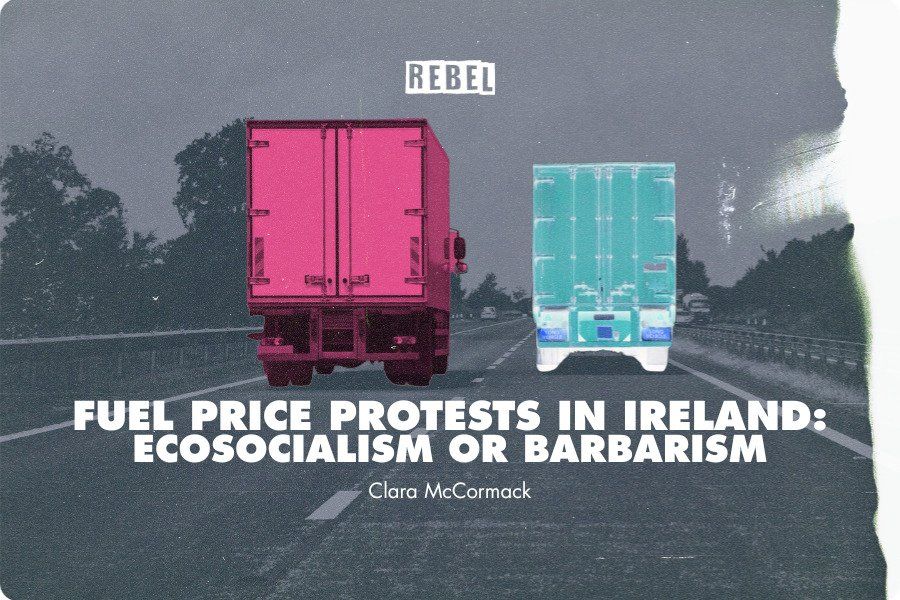
On Tuesday 7th April, major roads and towns in Ireland were brought to a standstill by hundreds of tractors, trucks, and buses. The fuel prices protests were sparked by the US-Israeli imperialist war on Iran, which caused the Strait of Hormuz to be blocked off, disrupting fossil fuel supply globally. In response, hundreds of farmers, hauliers, contractors, and supporters have shut down Dublin city, Whitegate Oil Refinery in Cork, and ports and thoroughways in Limerick, Galway, Wexford and other areas. The organisation was very loose and localised, mostly done through WhatsApp groups. A few figures have attempted to ‘claim’ the protests, including far-right agitators and wealthy contractors.
The basic demands of the protests are clear: cap fuel prices, and stop the carbon tax. These are demands that can work for workers, but the key political question is who pays for it? Will it be the working class that pays, or the wealthy?
This article attempts to outline the political and class character of the ongoing fuel price protests, and argue that the left must see the potential galvanising power of the protests. The left must acknowledge the presence of the far-right in the movement, without allowing that to deter us from intervening. The working class can push the political demands into a progressive, anti-war, anti-capitalist direction. We must sideline the fascists who attempt to shape this movement, by winning the farming, haulage, and other workers to our position. We must also recognise how the environmental movement has been co-opted by liberalism or ‘Green’ capitalism, and fight for an ecosocialist alternative that centres the working class.
A Protest Movement of the Left, or Right?
In January, agricultural contractor James Geoghegan attended a protest in which Irish Members of the European Parliament (MEPs) were called on to vote against the EU-Mercosur Partnership Agreement, a trade deal which would reduce tariffs on agricultural trade between the two trading blocs. In the Mercosur economic area (Brazil, Argentina, Paraguay, Uruguay), huge swathes of the Amazonian rainforest are being violently - and often illegally - razed, to create arable land for crops and pasture for animal farming. This trade deal will massively expand the consumer base (the EU) for products grown on this land, with major increases in Argentinian and Brazilian beef exports to the EU. Farmers are opposed to this deal because it will create greater competition with cheaper suppliers in South America, potentially hurting their profits.
For the twenty-odd years that the EU-Mercosur trade deal has been on the table, environmental activists have warned of the devastating environmental impact it will have - further destruction of the world’s largest carbon sink and an area of vast, irreplaceable biodiversity, the Amazon rainforest. Along with this destruction, the deal cements a deeply oppressive and extractive political economy: oppression which is used to justify illegal land theft, racism against indigenous people in South America, and reduction of the value of complex biodiverse environments to merely a profitable resource for consumption. This is capitalism and extractivism at its most fierce.
Interestingly, environmentalist activists fall on the same side of the argument about Mercosur as beef farmers in Europe. It may seem strange, as the interests and values of a profit-motivated beef farmer contrast sharply with that of the typical environmentalist. Yet in the wider scheme of capitalism - a system built of extractivism, oppression, and exploitation of land and labour - the interests of two vastly different cohorts can align in specific instances, at specific moments.
James Geoghegan, the supposed Public Relations Officer of the fuel price protest (according to the Irish Farmers Journal, 11/04/26), owner of Ventura Forestry Machines, is a member of the Irish Farmers Association and sits on its environment and rural affairs committee. He has been involved with protests against the EU-Mercosur deal in recent months, and is now one of the leading figures in the fuel price protests. In the Irish Times this week, it was reported that he was convicted in 2006 of 13 animal cruelty and neglect charges relating to the treatment of his farmed cattle. Over 60 cattle died in horrific circumstances on his farm in the space of a year. It was also reported that a separate business of his turned a profit of €300,000 in one year. Geoghegan’s own political views are staunchly right-wing: he voted for Independent Ireland in the last elections, and has openly admitted his racist views about immigration on social media. This is a figure who is clearly petit bourgeois, and ideologically far right. Similarly self-appointed ‘leading’ figures of the fuel prices protest also hold deeply reactionary political views, such as anti-immigration, violent misogyny, climate change denialism. Christopher Duffy, another contractor, posted online about climate and Palestine solidarity activist Greta Thunberg “I could care less if she got raped or beaten and I make no apologies for that”.
Despite this, there is massive public support for these protests. Many of the farmers and other workers participating have distanced themselves from the far right, saying that this is about fuel prices, not immigration. It has also become clear that there is no organised leadership yet - many protests are now localised and have broadened significantly. Workers affected by the traffic stoppages have voiced their support - despite being severely inconvenienced. Some commentators have even suggested that the protests open up new possibilities for the working class, such as the right to work from home, free and improved public transport, and ending reliance on fossil fuels.
Protest Movements and the Working Class
The fuel price protests were undoubtedly organised initially by petit bourgeois farming and haulage contractors, many with deeply reactionary views. However the protest now has the support of workers in the farming, haulage and bus driving industry, and broad public support. The movement, from the outset, had a mixed class character, and cannot be dismissed as entirely petit bourgeois. Similarly, while some of the organisers are clearly far-right, other organisers are staunch in their assertions that the protest is about fuel prices, not IPAS centres or immigration. As with all social movements, there is a mixed political character, and the end result will either depend on the actions of the petit bourgeois few at the top, or the masses of working class people who take up the mantle and put forward progressive demands. The politics that those masses put forward is a key factor in the outcome.
The socialist left should be wary of the potential for a protest movement in which the far right will try to radicalise it in a right-wing direction. Historically, fascism has arisen from the ‘squeezed middle’ or petit bourgeoisie in times of economic crisis – small businesses being squeezed between big businesses from above, and the organised working class from below. Recognising that the real power to change society comes from the masses of the working class, the petit bourgeoisie attempt to consolidate a support base of workers and win them to their political demands which ultimately sell out the working class or punish a scapegoat section of the class (such as immigrants or a minority ethnic group). The experience of the Yellow Vests movement internationally shows that these protests can go either way. In France, the left made inroads into shaping the movement to meet the demands of the working class and build popular struggle against government austerity. By contrast, a similar movement in Canada turned into a reactionary far-right charade. The left therefore is faced with the task of clarifying the politics of this, and winning workers to our position.
The working class has the ability, above all other political forces, to shape this movement. While some of the initial organisers - the petit bourgeois ‘leaders’ such as Geoghegan and Duffy - hold reactionary views and a class interest that serves small business, they know that the real power to win lies not in a hundred tractors, but in a hundred thousand working class people. This is why the initial demands were vague (cap fuel prices and scrap the carbon tax) - because they needed to win popular support. This leaves space for the left to intervene, pushing those demands to the left (scrap the carbon tax for the working class, but tax the data centres and other major polluters; invest in renewable energy; cut ties with US and Israeli imperialism, ban the use of Shannon Airport by US military), rather than allowing the demands to be pushed to the right (tax cuts for big business only). This requires the left (parties, revolutionary socialists, trade unions, Palestine solidarity, environmental campaigners, feminists, ant-racists) to shape and lead the movement, rather than standing aside while the forces of reaction shape it into something hideous.
Where are the Trade Unions?
As the far right continued to attempt to co-opt the movement entirely, small business ‘leaders met with government representatives to agree their pay-outs. The movement risks fizzling out with nothing won for workers. However, the energy and disruption generated by the blockades has stirred many working class people who are struggling to pay heating bills and are experiencing a crippling housing and cost-living-crisis. At this moment, there is a chance for a mass working-class movement to emerge that can confront the Government.
Trade unions historically have been the vehicle through which workers fight for their rights, and improvements in their material living standards. Trade unions are the reason we have any rights at all as workers. Yet the trade unions are silent and passive at a time when they should be active and militant. Trade union membership is the lowest it has ever been, with many (especially young and migrant) workers in extremely precarious work with no union representation. This fuel protest highlights the stark need for trade unions to use the resources and organisation they have to mobilise workers against the FF-FG government, both to win improved living standards and to act as a bulwark against the rising tide of fascism.
The Industrial Relations Act (1990) in the south of Ireland which bans ‘political’ and solidarity strikes, is often cited by the trade union bureaucracy as a reason for their abject passivity. This Act marked the co-optation of the trade unions by the state, and was introduced in reaction to the Dunnes Stores Strikes against South African Apartheid, which contributed to the fall of the apartheid regime. The state, and capitalists globally, know the power of the working class (even shop floor workers) to bring about significant political change. They respond by buying off the leaders of the trade union movement and ‘de-politicising’ the right to collective action. The Industrial Relations Act should be scrapped, and the trade unions returned to vehicles that can allow workers to fight collectively for better lives.
Co-option of the environmental movement by Liberals and the Centre Right
“Environmentalism without class struggle is just gardening” - Chico Mendes
The environmental movement reached a peak in terms of mass mobilisation several years ago, before being totally co-opted by the liberal right and ‘Green’ capitalist forces. Evidence of this can be seen in the wave of electoral support for Green parties in Ireland and elsewhere, who speak to the urgency of addressing the global climate catastrophe, but do not identify capitalism as the cause. This fatal political error means they tend to opt for ‘green capitalist’ solutions to climate catastrophe - ranging from ‘green’ technology, to carbon ‘offsetting’ (i.e. donate money to plant trees to sequester an amount of carbon equivalent to what might be emitted by your car), or carbon taxes on the working class. All of these ‘solutions’ are designed to allow capitalism to continue to function as it always has - extracting resources from the land, from the labour of people, and polluting our environments with complete disregard for life and the future of life on Earth - in the pursuit of profit. What is the use in planting a few trees when the system of food production we rely on is run for profit, requires constant growth and expansion, and the razing of millions of hectares of ancient rainforest a day? It makes far more sense to protect the carbon sequestering environments we have already - forests, oceans, bogs - than to destroy these environments for the profits of the wealthiest in society, who then try to convince us of the importance and efficacy of carbon offsets and green technology. The scale and depth of the climate crisis requires nothing short of revolutionary, anti-capitalist action to be addressed.
Revolutionary socialists are uniquely placed to offer an understanding of where environmentalism can coincide with the interests of the rural and agricultural working class. Any solution to the climate crisis must put the needs of the working class (as opposed to the needs of big business) to the fore. This means scrapping the carbon tax for workers and households, instead taxing major fossil fuel companies and corporations. We also need to move away from reliance on fossil fuels, which are not only harmful to the environment but leave us vulnerable to the belligerent whims of imperialist powers like the US and Israel. By investing in renewable energy, investing in public transport, taxing major polluters and data centres, we can move towards a just transition away from capitalism and extractivism and towards a just transition based on the democratic ownership of our energy resources.
These are not just demands that benefit the ‘urban’ working class, but can save the entire working class, including rural communities, from environmental destruction. Without addressing the capitalist social inequalities (including class, nationality, racism and misogyny) that have produced climate catastrophe, we will lose.
"Send the Army In!"
On the left we are very familiar with peaceful protests being met with excessive force from police. In the last five years, there have been major attacks on Palestine solidarity activists, striking workers, environmental activism and more. The Gardaí have intervened heavy-handedly and Justice Minister Jim O’Callaghan threatened to bring in the army, which would have set a dire precedent.
The reality is that, while the class composition of the protest is mixed, this is a group of people who are putting themselves on the line to fight the government on fuel prices and carbon taxes. The Fianna Fáil-Fine Gael government only wanted to negotiate with the self-appointed ‘leaders’ of the fuel prices protest, the petit bourgeois figures who have reactionary politics and a class interest that clashes with the interests of workers. But the movement and the opposition to devastating price increases has already broadened far beyond the control of those few, and it must continue to broaden its demands to meet the needs of the working class.
The government has condemned the protests, and the media is quick - uncharacteristically - to point out the far-right leanings of some of the organisers. Interestingly, the government and media were very slow on the uptake of criticising the far right when they were organising to burn down asylum centres, IPAS centres, and attacking people of colour, homeless people, immigrants and trans people in the streets. When fascists in the National Party, Irish Freedom Party, loyalist groups or the National Front organised racist demonstrations and pogroms in cities and towns across the island, it was the socialist left and groups like United Against Racism that came out to counter them - to point out their clearly racist motivations and to stand in solidarity with the targets of xenophobic abuse. We should not shy away from confronting the far right in any area, or any movement. We should also not allow them to co-opt movements that can challenge the state and capitalism. United, the working class can win.
Some far-right agitators have been voicing support for Trump throughout these protests. The belligerence of US imperialism and the genocidal project of Zionism has created this acute crisis. Trump sparked a war with Iran, and Israel’s attacks on Lebanon are forcing the war to continue. Combined with our dependence on fossil fuels, the severity of the crisis is manifesting in ways that no one can ignore.
Never before have the pitfalls of the Irish state’s alliance with Western imperialism, its complicity with genocide, its protection of the interests of fossil capital been laid so bare for the world to see. While the ruling elites fight their imperialist wars, working class people suffer exorbitant fuel and food prices and shortages. They fight for profit, we fight to survive. The petit bourgeois figures, the likes of James Geoghegan, will gladly sell out the working class if given the chance - ordinary people in both rural and urban areas must unite to fight against the government, the petit bourgeois sellouts, and the capitalist system they uphold.
The movement has already gained popular support, now the trade unions and left parties must organise and mobilise people across the island in support of anti-austerity, anti-imperialist demands. Where far-right agitators rear their heads, we must oppose them. Where the establishment attempts to paint an entire fuel prices protest movement as far-right, we have to find ways to link the movement with the fight against rent hikes, against homelessness and evictions and push back the government’s pro-business, right wing agenda. Where they attack working class people who are immigrants, queer, or otherwise don’t fit the far-right conception of ‘Irish’, we must mobilise to defend our class and fight the real enemy – capitalism.